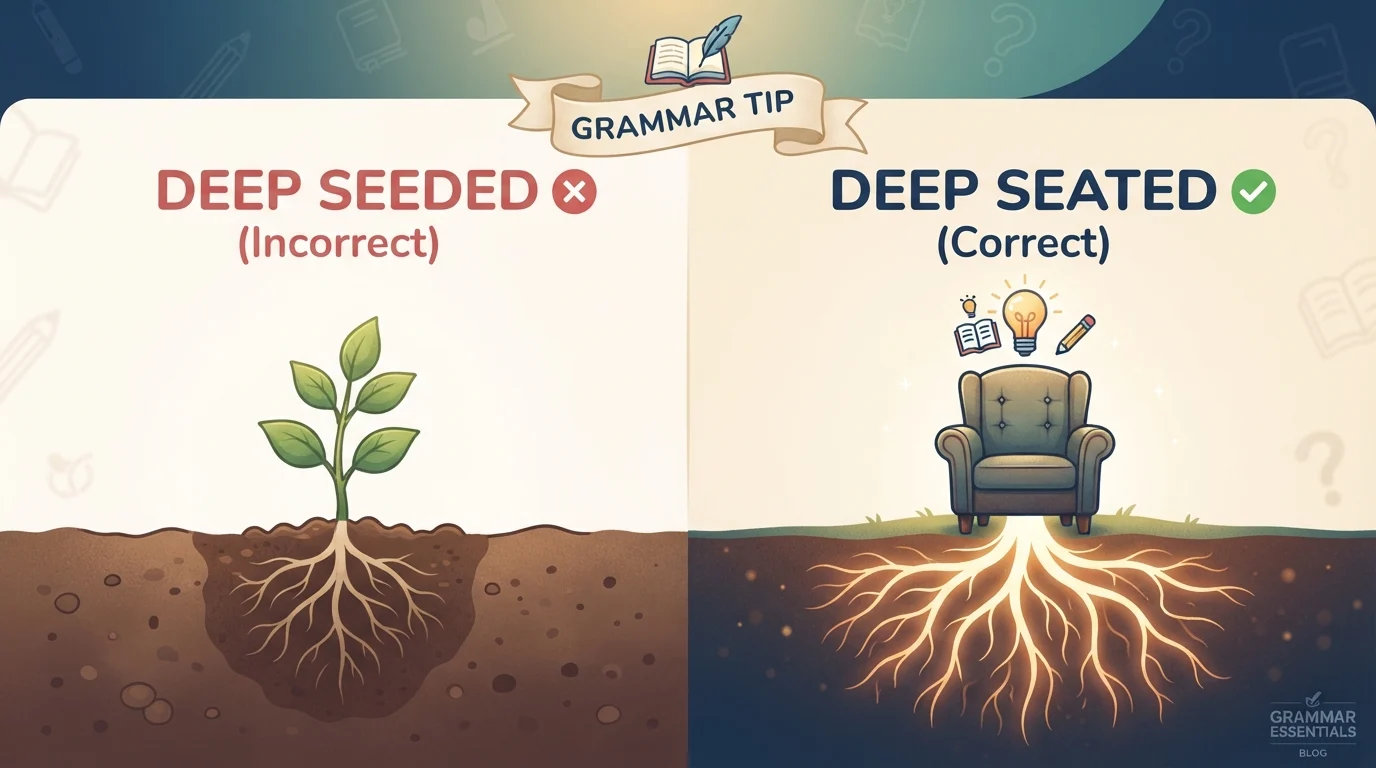
The correct phrase is deep seated, not deep seeded, when you are talking about a deeply rooted belief, feeling, fear, problem, or attitude.
For example:
- She has a deep seated fear of public speaking.
- The organization has deep seated problems.
- He has deep seated beliefs about family and tradition.
Quick Answer
Deep seated = firmly established or deeply rooted.
Deep seeded = usually a mistaken version of deep seated when used in this context.
Easy memory trick
Think of something being firmly seated in your mind or emotions.
Deep seated = deeply established.
What Does “Deep Seated” Mean?
Deep seated is an adjective used to describe something that is strongly established, deeply rooted, or difficult to change.
It commonly describes:
- Beliefs
- Fears
- Emotions
- Resentment
- Problems
- Conflicts
- Attitudes
- Prejudices
- Concerns
Examples
- She has a deep seated fear of failure.
- The country faces deep seated social problems.
- He felt deep seated resentment toward his former employer.
- They have deep seated cultural traditions.
- The two groups have a deep seated conflict.
Why Is “Deep Seated” Correct?
The word seated suggests something that is firmly placed or settled in a position.
Over time, deep seated developed a figurative meaning: something is firmly established deep within a person’s mind, emotions, or a larger system.
For example:
A deep seated belief is a belief that is firmly established in someone’s mind.
What About “Deep Seeded”?
Deep seeded is commonly used as a mistaken version of deep seated.
The word seeded itself is a real word, especially when talking about planting or placing seeds.
For example:
- The farmer seeded the field.
- The garden was seeded with grass.
- The tournament was seeded according to rankings.
However, when you mean something is deeply rooted or firmly established, use deep seated.
Incorrect in standard usage:
❌ He has a deep seeded fear of flying.
Correct:
✅ He has a deep seated fear of flying.
Deep-Seeded vs Deep-Seated Comparison
| Phrase | Standard for “deeply rooted”? | Meaning |
|---|---|---|
| Deep seated | Yes | Firmly established or deeply rooted |
| Deep seeded | No, generally | Usually a mistaken version of deep seated |
Deep Seated vs Deep Rooted
Deep seated and deep rooted are often synonyms.
Deep seated
Commonly describes beliefs, feelings, fears, and problems.
- Deep seated anxiety
- Deep seated resentment
- Deep seated beliefs
Deep rooted
Often describes traditions, customs, problems, and cultural practices.
- Deep rooted traditions
- Deep rooted inequality
- Deep rooted cultural beliefs
Both phrases can mean something is firmly established and difficult to change.
Common Mistakes
Mistake 1: Deep seeded fear
❌ She has a deep seeded fear of dogs.
✅ She has a deep seated fear of dogs.
Mistake 2: Deep seeded beliefs
❌ His deep seeded beliefs influenced his decision.
✅ His deep seated beliefs influenced his decision.
The hyphen is commonly used because deep seated functions as a compound adjective before the noun.
Mistake 3: Using “deep-seated” for literal seeds
If you are literally talking about seeds planted deep in soil, deep seated is not the right word.
A clearer sentence would be:
- The seeds were planted deep in the soil.
American vs British English
The standard expression deep seated is used in both American English and British English.
There is no major difference in spelling or meaning between the two varieties of English. You may see deep seeded in informal writing or online content, but deep seated remains the standard choice in professional, academic, and edited writing.
Quick Practice
Choose the correct phrase:
- She has a ______ fear of heights.
- The company has ______ financial problems.
- His ______ resentment affected their relationship.
- The country faces ______ social inequality.
Answers
- deep seated
- deep seated
- deep seated
- deep seated
Is “deep seated” or “deep seeded” correct?
Deep seated is correct when you mean deeply rooted, firmly established, or difficult to change.
Is “deep seated fear” correct?
Yes. Deep seated fear is a common and correct phrase.
Is “deep seeded beliefs” correct?
No, not in standard usage. The correct phrase is deep seated beliefs.
What does deep seated mean?
It means firmly established, deeply rooted, strongly held, or difficult to change.
Why do people say deep seeded?
It is usually a common mishearing or misspelling of deep seated. The word seeded may seem logical because something deeply rooted can be compared to a planted seed.
Is deep-seated hyphenated?
Yes, it is commonly written as deep seated when it comes before a noun, such as deep seated beliefs or deep seated problems.
What is a synonym for deep-seated?
Depending on the context, synonyms include deep rooted, deeply ingrained, firmly established, strongly held, and entrenched.
Final Summary
The correct expression is deep seated when you mean something that is deeply rooted, firmly established, or difficult to change. Examples include deep seated fears, deep seated beliefs, deep seated resentment, and deep seated problems.
Although deep seeded is sometimes used, it is generally considered a mistaken version of deep seated in this context. Remember the simple rule: If something is firmly established in your mind, emotions, or society, it is deep seated.
Actionable Takeaway
Use deep seated, not deep seeded, when describing a deeply rooted belief, feeling, fear, attitude, or problem.