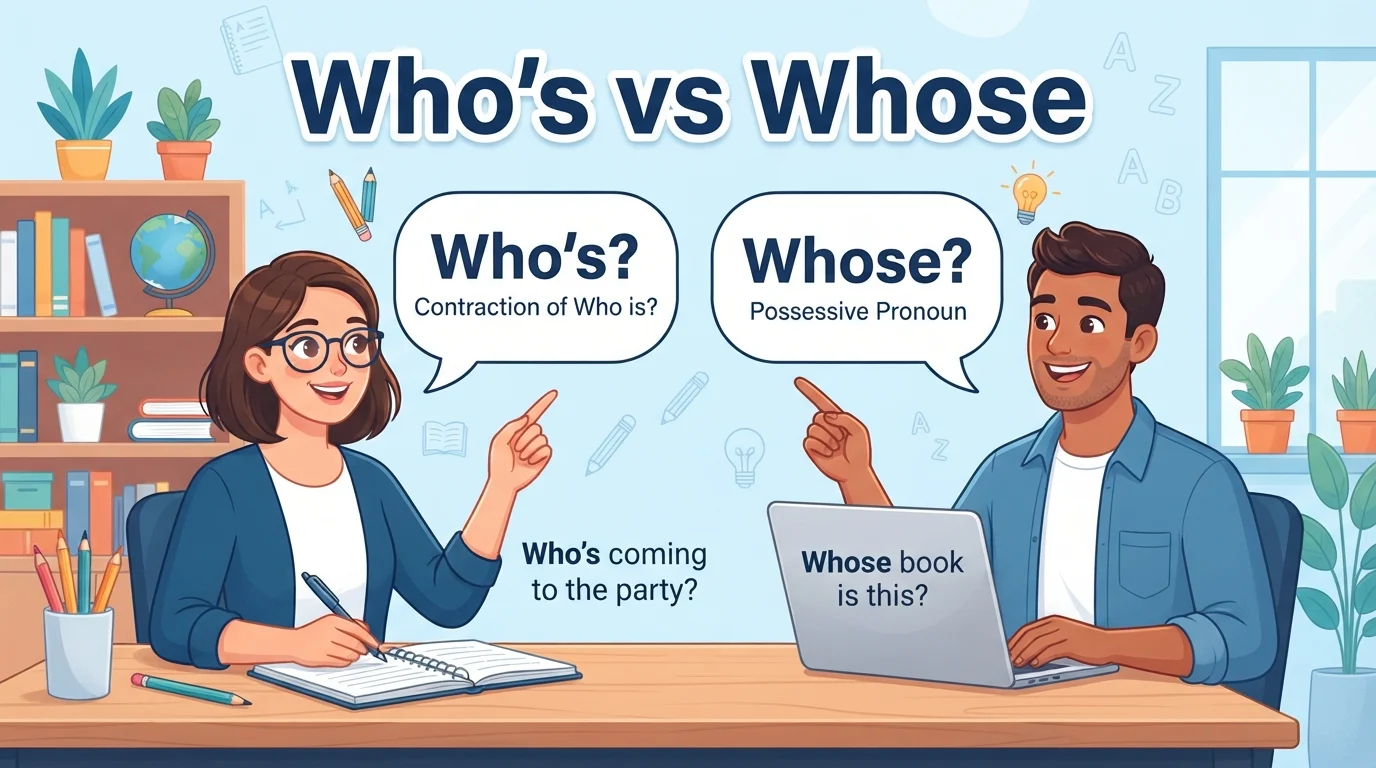
Have you ever wondered if to write who’s or whose? These two words sound exactly the same in many varieties of English, which makes them easy to confuse. However, they have completely different meanings and are used in different ways.
The good news is that the difference between who’s vs whose is simple once you know one important rule. Who’s is a contraction meaning who is or who has, while whose shows possession or asks who something belongs to. With a few simple examples, you can easily remember which word to use.
Quick Answer: Who’s vs Whose
Who’s = who is or who has
Whose = belonging to whom or belonging to which person
Examples:
- Who’s coming to the party? = Who is coming to the party?
- Who’s finished the work? = Who has finished the work?
- Whose phone is this? = Who does this phone belong to?
- Whose idea was it? = Which person’s idea was it?
Easy memory trick
If you can replace who’s with who is or who has, use who’s.
If you are talking about ownership or possession, use whose.
What Does “Who’s” Mean?
Who’s is a contraction. A contraction combines two words into a shorter form.
Who’s can mean:
- Who is
- Who has
The apostrophe replaces the missing letters in the original words.
“Who’s” meaning “who is”
Examples:
- Who’s at the door?
- Who’s your teacher?
- Who’s responsible for this project?
- Who’s coming with us?
- Who’s ready to begin?
You can expand each sentence:
- Who’s at the door? → Who is at the door?
- Who’s your teacher? → Who is your teacher?
- Who’s coming with us? → Who is coming with us?
If who is makes sense, who’s is correct.
“Who’s” meaning “who has”
Who’s can also be a contraction of who has.
Examples:
- Who’s finished the assignment?
- Who’s seen my keys?
- Who’s already left?
- Who’s been to London?
For example:
Who’s seen my phone?
means:
Who has seen my phone?
What Does “Whose” Mean?
Whose is a possessive word. It asks or explains who owns something or who something belongs to.
Examples:
- Whose book is this?
- Whose car is parked outside?
- Whose jacket did you borrow?
- Whose idea was it?
- Whose turn is it?
In each sentence, whose relates to possession, ownership, or association.
Example:
Whose phone is ringing?
This means:
Who does the phone belong to?
The phone may belong to one of several people, and the question asks about ownership.
Who’s vs Whose: The Main Difference
The simplest way to understand who’s vs whose is to look at their grammatical roles.
| Word | Meaning | Function | Example |
|---|---|---|---|
| Who’s | Who is / who has | Contraction | Who’s coming? |
| Whose | Belonging to whom | Possessive word | Whose bag is this? |
The substitution test
Try replacing who’s with:
- Who is
- Who has
If the sentence still makes sense, use who’s.
Example:
Who’s calling?
→ Who is calling?
Correct.
Now try:
Whose calling?
→ Who is calling?
This does not work, so whose is incorrect.
For possession:
Whose phone is this?
You cannot replace whose with who is or who has.
Therefore, whose is correct.
Who’s vs Whose Examples
Seeing the two words side by side can make the difference easier to understand.
Examples with “who’s”
- Who’s coming to dinner?
- Who’s your favorite author?
- Who’s responsible for the mistake?
- Who’s been using my computer?
- Who’s going to help us?
- Who’s already completed the task?
Examples with “whose”
- Whose coat is this?
- Whose keys are on the table?
- Whose turn is it?
- Whose advice did you follow?
- Whose name is on the list?
- Whose responsibility is this?
Common Mistakes With Who’s and Whose
Because these words sound alike, even experienced English speakers sometimes confuse them.
Mistake 1: Using “whose” instead of “who’s”
❌ Whose going to the meeting?
✅ Who’s going to the meeting?
The correct sentence is:
Who is going to the meeting?
Therefore, who’s is correct.
Mistake 2: Using “who’s” to show possession
❌ Who’s phone is this?
✅ Whose phone is this?
The question asks who owns the phone, so whose is correct.
Mistake 3: Assuming the apostrophe always means possession
This is a common grammar mistake.
In many English words, an apostrophe can show possession:
- Sarah’s book
- The dog’s bowl
However, in who’s, the apostrophe does not show possession. It represents missing letters in who is or who has.
A Simple Memory Trick for Who’s vs Whose
Remember:
Who’s = who is or who has.
Whose = ownership.
You can think of the s in whose as connected to the idea of someone’s possession.
For example:
- Whose book? → Someone’s book.
- Whose car? → Someone’s car.
- Whose idea? → Someone’s idea.
Another useful sentence is:
Who’s coming, and whose car are we taking?
The first word asks about a person. The second asks about ownership.
Who’s vs Whose in American and British English
The basic difference between who’s and whose is the same in both American English and British English.
Both varieties use:
- Who’s for who is or who has
- Whose for possession
Pronunciation may vary slightly depending on regional accent, but the words are commonly pronounced similarly or identically in everyday speech.
This is why context and grammar are especially important when listening.
Who’s vs Whose in Formal and Informal Writing
Who’s is perfectly acceptable in everyday writing, conversations, emails, messages, and most general content.
For example:
- Who’s available for the meeting?
- Who’s responsible for this task?
In highly formal writing, you may choose to write the full form:
- Who is responsible for this task?
However, whose is not a shortened form and should not be replaced with who’s.
Related Words: Whom, Who, and Whoever
Understanding related question words can also improve your grammar.
Who
Who usually refers to the person performing an action.
Example:
- Who called you?
Whom
Whom traditionally refers to the person receiving an action.
Example:
- Whom did you invite?
In modern everyday English, many speakers use who instead of whom in informal situations.
Whoever
Whoever means any person who or the person who.
Example:
- Whoever finishes first can leave.
Whose
Whose shows possession.
Example:
- Whose notebook is this?
When Should You Use “Who’s” or “Whose”?
Use who’s when you mean:
- Who is
- Who has
Examples:
- Who’s ready? → Who is ready?
- Who’s finished? → Who has finished?
Use whose when asking about possession or ownership.
Examples:
- Whose bag is this?
- Whose responsibility is it?
- Whose opinion do you trust?
Quick test
Ask yourself:
Can I replace the word with “who is” or “who has”?
- Yes → who’s
- No, and the sentence involves ownership → whose
Who’s vs Whose: Quick Practice
Choose the correct word:
- ______ coming to the party?
- ______ shoes are these?
- ______ been using my laptop?
- ______ idea was this?
- ______ responsible for the report?
- ______ phone is ringing?
Answers
- Who’s
- Whose
- Who’s
- Whose
- Who’s
- Whose
Why Are Who’s and Whose So Commonly Confused?
The main reason is pronunciation. In many accents, who’s and whose sound the same or nearly the same.
Their spelling is also similar, and both words relate to people. The apostrophe in who’s can make the confusion worse because learners may incorrectly assume it shows possession.
The best way to avoid mistakes is to focus on meaning rather than sound.
Ask yourself:
Am I asking who someone is or what someone has done?
Use who’s.
Am I asking who owns something?
Use whose.
Is “who’s” short for “who is”?
Yes. Who’s can be a contraction of who is.
Example: Who’s coming? = Who is coming?
Can “who’s” also mean “who has”?
Yes. For example, Who’s finished the work? means Who has finished the work?
Is “whose” possessive?
Yes. Whose is used to ask about ownership, possession, or association.
Example: Whose bag is this?
What is the easiest way to remember who’s vs whose?
Remember: Who’s = who is or who has. Whose = ownership.
Is “whose going to the party” correct?
No. The correct sentence is Who’s going to the party? because it means Who is going to the party?
Is “who’s book is this” correct?
No. The correct sentence is Whose book is this? because the question asks who owns the book.
Are who’s and whose pronounced the same?
They are often pronounced the same or very similarly, depending on the speaker’s accent. Their meanings and grammatical uses are different.
Do American and British English use who’s and whose differently?
No. The basic rules are the same in both American and British English. Who’s means who is/who has, while whose expresses possession.
Final Summary: Who’s vs Whose
The difference between who’s vs whose becomes easy when you remember their functions. Who’s is a contraction of who is or who has, while whose is used to ask about possession or ownership. For example, Who’s coming? means Who is coming?, while Whose bag is this? asks who owns the bag.
Because who’s and whose often sound the same, it is easy to confuse them when speaking or writing quickly. The best strategy is to use the replacement test: if who is or who has fits, choose who’s. If the sentence asks about ownership, choose whose.
Actionable Takeaway
Remember this simple rule: Who’s = who is/who has; whose = belonging to whom. Before submitting your writing, replace who’s with “who is” or “who has.” If the sentence still makes sense, you have chosen the correct word.