Have you ever stopped while writing and wondered if you should use breath or breathe? You are not alone. These two English words look and sound closely related, but they have different meanings and grammatical functions.
Understanding the difference between breath vs breathe can instantly improve your spelling, grammar, pronunciation, and everyday communication.
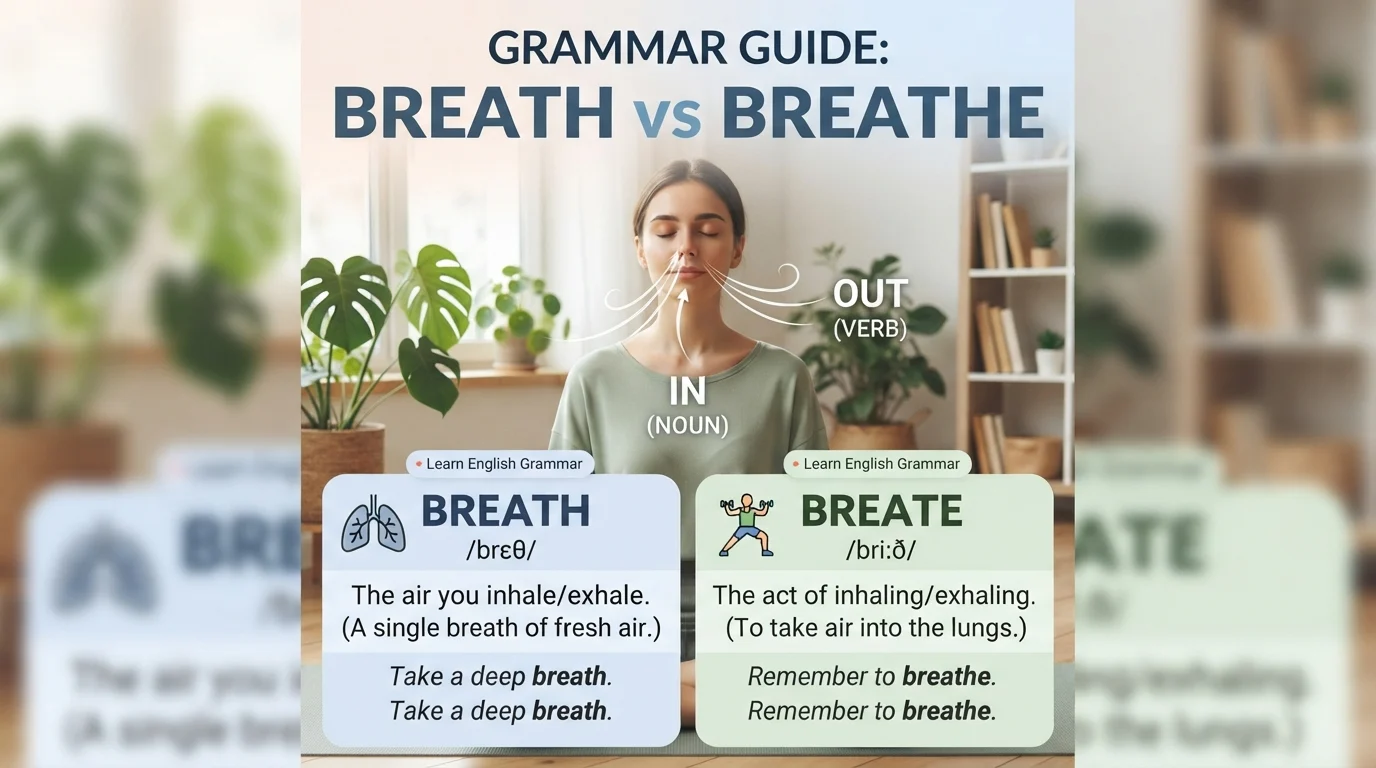
The easiest way to remember the difference is simple: breath is a noun, while breathe is a verb. In other words, you take a breath, but you breathe air. Once you understand this basic distinction, choosing the correct word becomes much easier.
Quick Answer: Breath vs Breathe
Breath is a noun that means the air you take in or let out.
Breathe is a verb that means to inhale and exhale air.
Simple example:
- Take a deep breath.
- Breathe slowly and relax.
A helpful pronunciation tip is that breath usually has a short “e” sound, like breth, while breathe has a long “ee” sound, like breeth.
What Does “Breath” Mean?
Breath is a noun. It refers to the air that enters or leaves your lungs when you inhale and exhale.
It can also describe a single act of inhaling or exhaling.
Examples of “breath”
- I took a deep breath before speaking.
- She held her breath underwater.
- His breath was visible in the cold air.
- After running, I was out of breath.
- Take a slow breath and calm down.
In each example, breath names something: the air or the act of taking air in and letting it out.
Common phrases with “breath”
You will often see breath used in familiar expressions, including:
- Take a deep breath
- Hold your breath
- Catch your breath
- Out of breath
- A breath of fresh air
- Bad breath
- With bated breath
- Under your breath
For example:
After climbing the stairs, I had to stop to catch my breath.
What Does “Breathe” Mean?
Breathe is a verb. It describes the action of taking air into your lungs and releasing it.
When you inhale and exhale, you breathe.
Examples of “breathe”
- Remember to breathe slowly.
- Humans breathe oxygen.
- It is difficult to breathe in thick smoke.
- She stopped talking to breathe.
- The doctor told him to breathe deeply.
Because breathe is an action word, it usually describes what someone or something does.
Breath vs Breathe: The Main Difference
The easiest way to understand breath vs breathe is to identify the part of speech.
| Word | Part of Speech | Meaning | Example |
|---|---|---|---|
| Breath | Noun | Air taken in or released | Take a deep breath. |
| Breathe | Verb | The action of inhaling and exhaling | Breathe deeply. |
Easy memory trick
Think of the final e in breathe as adding extra sound and action.
- Breath = a thing
- Breathe = an action
You can take a breath, but you breathe.
Breath vs Breathe Pronunciation
Pronunciation is another major difference between these two commonly confused words.
Breath
Breath is pronounced approximately like:
breth
The vowel sound is short, similar to the sound in words such as “death” or “left.”
Breathe
Breathe is pronounced approximately like:
breeth
The vowel sound is longer, similar to the sound in “need” or “see.”
The final th sound can also be slightly different. In breath, the sound is generally voiceless, while in breathe, the “th” sound is voiced.
However, pronunciation can vary slightly depending on a speaker’s accent.
Breath vs Breathe Examples in Sentences
Seeing the words in context makes the difference much easier to understand.
Examples using “breath”
- He took a deep breath before entering the room.
- I could feel her warm breath on my hand.
- The athlete was completely out of breath.
- Hold your breath for five seconds.
- The forest was a welcome breath of fresh air.
Examples using “breathe”
- Try to breathe through your nose.
- The baby is learning to breathe independently.
- It is hard to breathe at high altitudes.
- Please breathe in and out slowly.
- Plants also breathe through processes related to gas exchange.
Common Mistakes With Breath and Breathe
Because the words are related, many writers accidentally use one in place of the other. Here are some of the most common mistakes.
Mistake 1: Using “breathe” after “take”
❌ Take a deep breathe.
✅ Take a deep breath.
The phrase requires a noun, so breath is correct.
Mistake 2: Using “breath” for an action
❌ Remember to breath deeply.
✅ Remember to breathe deeply.
The sentence describes an action, so the verb breathe is needed.
Mistake 3: Confusing “out of breath” and “out of breathe”
❌ I am out of breathe.
✅ I am out of breath.
The correct phrase is always out of breath.
Mistake 4: Confusing “breathe” and “breathing”
❌ She is breath heavily.
✅ She is breathing heavily.
The word breathing is the ing form of the verb breathe.
A Simple Trick to Remember Breath vs Breathe
Here is one of the easiest memory tricks:
You take a breath, but you breathe.
You can also remember this pattern:
- Breath = noun = thing
- Breathe = verb = action
Try replacing the word with another noun or verb.
For example:
Take a deep breath.
You could say:
Take a deep sip.
Both “breath” and “sip” are things or actions treated as nouns in this structure.
Now consider:
Breathe slowly.
You could say:
Walk slowly.
Both “breathe” and “walk” are verbs.
Breath vs Breathe in American and British English
The meanings of breath and breathe are essentially the same in American English and British English. The spelling does not change between the two varieties of English.
However, pronunciation may vary slightly because of regional accents.
For example, speakers from different parts of the United States, the United Kingdom, Australia, and other English speaking regions may pronounce the r sound or vowel sounds differently. Despite these accent differences, the grammatical distinction remains the same:
- Breath = noun
- Breathe = verb
So If you are writing in American English or British English, the same basic rule applies.
Related Words: Breathing, Breathless, and Breathable
Understanding related words can make the difference even clearer.
Breathing
Breathing is the present participle or gerund form of breathe.
Example:
- She is breathing normally.
Breathless
Breathless means unable to breathe easily or extremely excited.
Examples:
- I was breathless after running.
- The breathtaking view left us breathless.
Breathable
Breathable describes a material that allows air to pass through it.
Example:
- This shirt is made from lightweight, breathable fabric.
Breathtaking
Breathtaking can mean extremely beautiful, impressive, or surprising.
Example:
- The mountain view was breathtaking.
These related words all connect back to the same basic word family.
When Should You Use “Breath” or “Breathe”?
Use breath when you are talking about the air itself or one instance of inhaling and exhaling.
Example:
- She took a deep breath.
Use breathe when you are talking about the action of inhaling and exhaling.
Example:
- She began to breathe slowly.
Quick test
Ask yourself:
Am I naming something?
Use breath.
Am I describing an action?
Use breathe.
Breath vs Breathe: Quick Practice
Choose the correct word in each sentence:
- Take a deep ______ before you begin.
- Try to ______ slowly.
- He was out of ______ after the race.
- It is important to ______ fresh air.
- She held her ______ underwater.
Answers
- breath
- breathe
- breath
- breathe
- breath
If you got them all correct, you have understood the main difference between these two commonly confused English words.
Why Are Breath and Breathe So Easy to Confuse?
The confusion happens because both words come from the same word family and have almost identical spellings. They also refer to closely connected ideas involving air and respiration.
The extra e in breathe changes both the pronunciation and the grammatical role of the word. This is why spelling the word correctly matters.
Many English learners also confuse them because English spelling does not always provide a perfectly predictable pronunciation pattern. Reading both words in complete sentences is one of the best ways to remember the difference.
Is “breath” a noun or a verb?
Breath is a noun. It refers to air taken into or released from the lungs, or to a single act of inhaling and exhaling.
Is “breathe” a noun or a verb?
Breathe is a verb. It describes the action of inhaling and exhaling air.
What is the easiest way to remember breath vs breathe?
Remember this sentence: You take a breath, but you breathe. “Breath” is a noun, while “breathe” is a verb.
Is “take a deep breath” correct?
Yes. Take a deep breath is the correct phrase. Take a deep breathe is incorrect.
Is “breathe deeply” correct?
Yes. Breathe deeply is correct because “breathe” describes the action of inhaling and exhaling.
Do American and British English spell breath and breathe differently?
No. The spelling and basic meanings are the same in both American and British English. Pronunciation may vary slightly by accent.
What is the difference between “breath” and “breathing”?
Breath is a noun, while breathing is the ing form of the verb breathe. For example: “Take a breath” and “She is breathing slowly.”
How do you pronounce breath and breathe?
Breath is generally pronounced like “breth,” while breathe is generally pronounced like “breeth.” Regional accents may create slight variations.
Final Summary: Breath vs Breathe
The difference between breath vs breathe is simple once you focus on grammar. Breath is a noun that refers to air or a single act of inhaling and exhaling.
Breathe is a verb that describes the action of taking air into your lungs and releasing it. The easiest rule to remember is: You take a breath, but you breathe.
If you are writing an email, completing an English assignment, improving your vocabulary, or learning English as a second language, this simple distinction can help you avoid a very common spelling and grammar mistake.
When in doubt, ask yourself whether you need a noun or a verb and the correct word will usually become clear.
Actionable Takeaway
Use this one-line memory trick today: “I take a breath, and I breathe.” Repeat it a few times, write your own two example sentences, and you will quickly master the difference between breath and breathe.