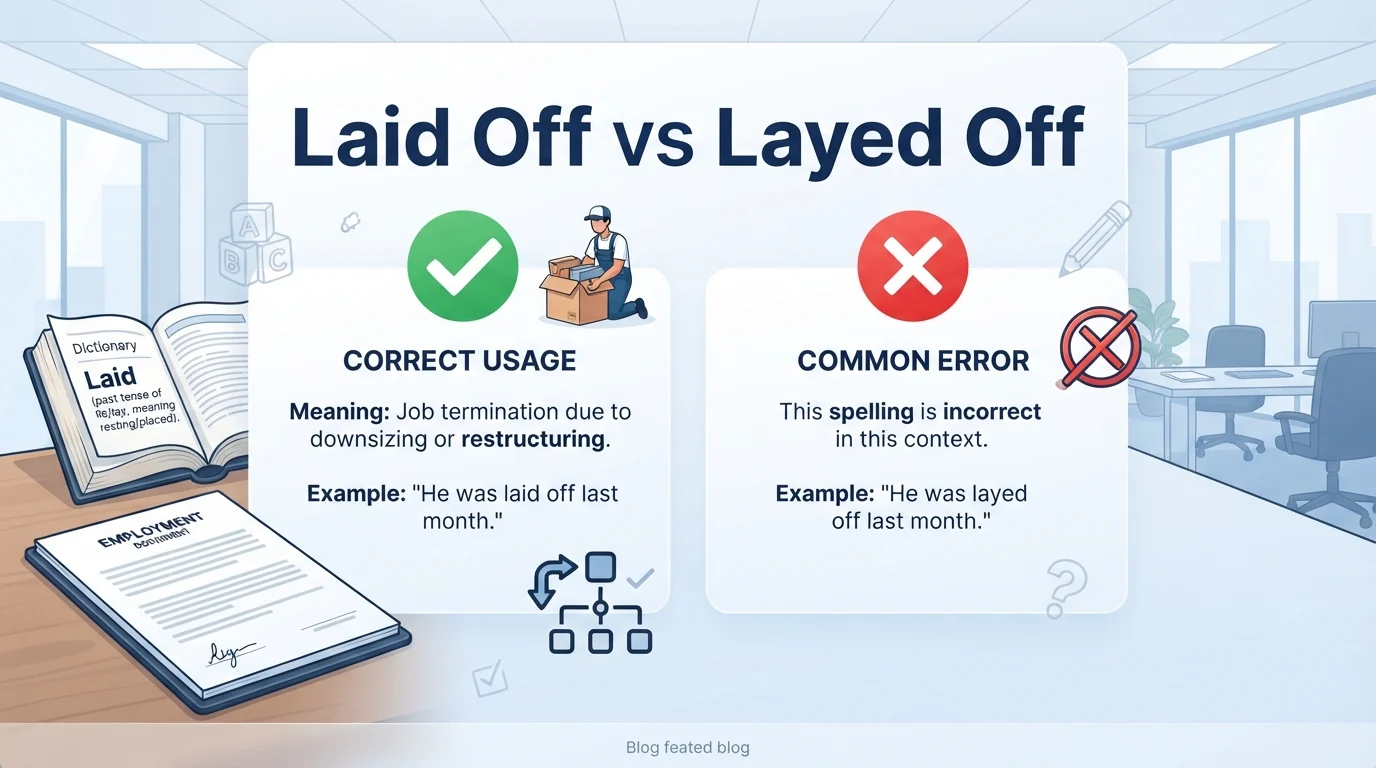
Have you ever wondered whether the correct phrase is “laid off” or “layed off”? You’re not alone. This is a common English spelling mistake because the verb lay can be confusing, especially when used in the past tense.
The correct phrase is “laid off.” “Layed off” is not standard English. In this guide, you’ll learn the difference between laid off vs layed off, understand what laid off means, see clear examples, learn common mistakes, and discover a simple way to remember the correct spelling.
Quick Answer
“Laid off” is correct.
“Layed off” is incorrect in standard English.
- ✅ Laid off = An employee’s job was ended by an employer, often because of business or economic reasons.
- ❌ Layed off = Incorrect spelling.
Example:
- The company laid off 100 employees.
- ❌ The company layed off 100 employees.
What Does “Laid Off” Mean?
Laid off is the past tense and past participle of lay off.
In employment contexts, to lay someone off means to end their employment, often because of:
- financial problems
- company restructuring
- reduced demand
- budget cuts
- downsizing
- business closure
A layoff is usually different from being fired for misconduct or poor performance.
Examples:
- The company laid off several workers.
- She was laid off after the factory closed.
- Many employees were laid off during the restructuring.
Why “Layed Off” Is Incorrect
The verb lay has an irregular past tense:
- Present: lay
- Past: laid
- Past participle: laid
Therefore:
- lay off → laid off
Not:
- ❌ layed off
Examples:
- The company lays off workers. (present)
- The company laid off workers. (past)
- The workers were laid off. (past participle/passive)
Laid Off vs Layed Off
| Phrase | Correct? | Meaning |
|---|---|---|
| Laid off | ✅ Yes | Employment was ended, often because of business reasons |
| Layed off | ❌ No | Incorrect spelling |
Whenever you’re deciding between laid off vs layed off, always choose laid off.
How to Use “Laid Off” Correctly
Active Voice
In active sentences, the employer or company performs the action.
- The company laid off 50 employees.
- The factory laid off several workers.
- The business laid off staff because of declining sales.
Passive Voice
In passive sentences, the employee receives the action.
- She was laid off last month.
- Hundreds of workers were laid off.
- He was laid off during the company’s restructuring.
Common Mistakes
The most common mistake is adding -ed to lay as if it were a regular verb.
Incorrect:
- ❌ The company layed off employees.
- ❌ I was layed off last year.
- ❌ They have layed off several workers.
Correct:
- ✅ The company laid off employees.
- ✅ I was laid off last year.
- ✅ They have laid off several workers.
Laid Off vs Fired
Although these terms are sometimes used similarly, they often have different meanings.
Laid Off
A person is often laid off because of circumstances affecting the employer, such as:
- downsizing
- budget cuts
- restructuring
- reduced business
Fired
A person is usually fired because of an issue related to their employment, such as:
- poor performance
- misconduct
- breaking company rules
Example:
- The company laid off employees because of budget cuts.
- The manager fired an employee for repeated misconduct.
The exact legal meaning of these terms can vary depending on the country and employment situation.
Easy Trick to Remember
Remember this simple rule:
Lay → Laid
The past tense of lay is laid, not layed.
So:
- lay off → laid off
- lay down → laid down
- lay out → laid out
Examples:
- The company laid off workers.
- She laid out the documents.
- He laid down the book.
American vs British English
The spelling laid off is standard in both American and British English.
Both varieties use:
- lay off = present tense
- laid off = past tense
- laid off = past participle
The phrase layed off is not standard in either variety when referring to employment termination.
Related Employment Terms
You may also see these phrases:
- laid off
- job loss
- downsized
- made redundant
- dismissed
- terminated
- furloughed
- unemployed
- workforce reduction
- company restructuring
In British English, made redundant is commonly used for a situation similar to being laid off in American English.
Example:
- American English: She was laid off.
- British English: She was made redundant.
Tips to Avoid This Mistake
Follow these simple strategies:
- Remember: lay → laid, never layed in standard English.
- Use laid off for employment-related job loss.
- Memorize the phrase as a fixed expression.
- Practice related forms such as laid out and laid down.
- Proofread carefully when writing about job changes or employment.
Frequently Asked Questions
Which is correct: laid off or layed off?
Laid off is correct. Layed off is an incorrect spelling in standard English.
What does “laid off” mean?
It means an employer ended someone’s employment, often because of financial difficulties, restructuring, downsizing, or reduced business needs.
Is “layed” a word?
Layed is not the standard past tense of lay. The correct past tense is laid.
Is “laid off” the same as “fired”?
Not always. Laid off often refers to job loss caused by business circumstances, while fired commonly refers to termination related to an employee’s conduct or performance.
What is the present tense of “laid off”?
The present-tense phrase is lay off.
Example:
- The company may lay off workers.
What is the past tense of “lay off”?
The past tense is laid off.
Example:
- The company laid off workers last year.
Do American and British English use “laid off” differently?
The spelling is the same. However, British English also commonly uses made redundant for a similar employment situation.
Summary
When comparing laid off vs layed off, the correct phrase is laid off. The word laid is the past tense and past participle of lay, so the correct forms are lay off in the present and laid off in the past. Layed off is a common spelling mistake but is not standard English.
The phrase laid off generally means that an employer ended someone’s job because of business reasons such as downsizing, restructuring, or financial difficulties. To remember the correct form, simply memorize lay → laid and avoid adding -ed to create layed.
Actionable Takeaway
Whenever you mean that someone lost a job because of an employer’s business decision, use laid off. Remember: lay off → laid off, never layed off.