The confusion between panic vs panick is a common English spelling mistake. Since some English words end with “ck,” many writers mistakenly assume that panic should also be spelled panick. However, standard English grammar follows a different rule.
If you’ve ever wondered whether to write panic or panick in messages, essays, emails, or professional writing, this guide explains the correct spelling, meaning, examples, grammar rules, common mistakes, and easy memory tricks.
Quick Answer
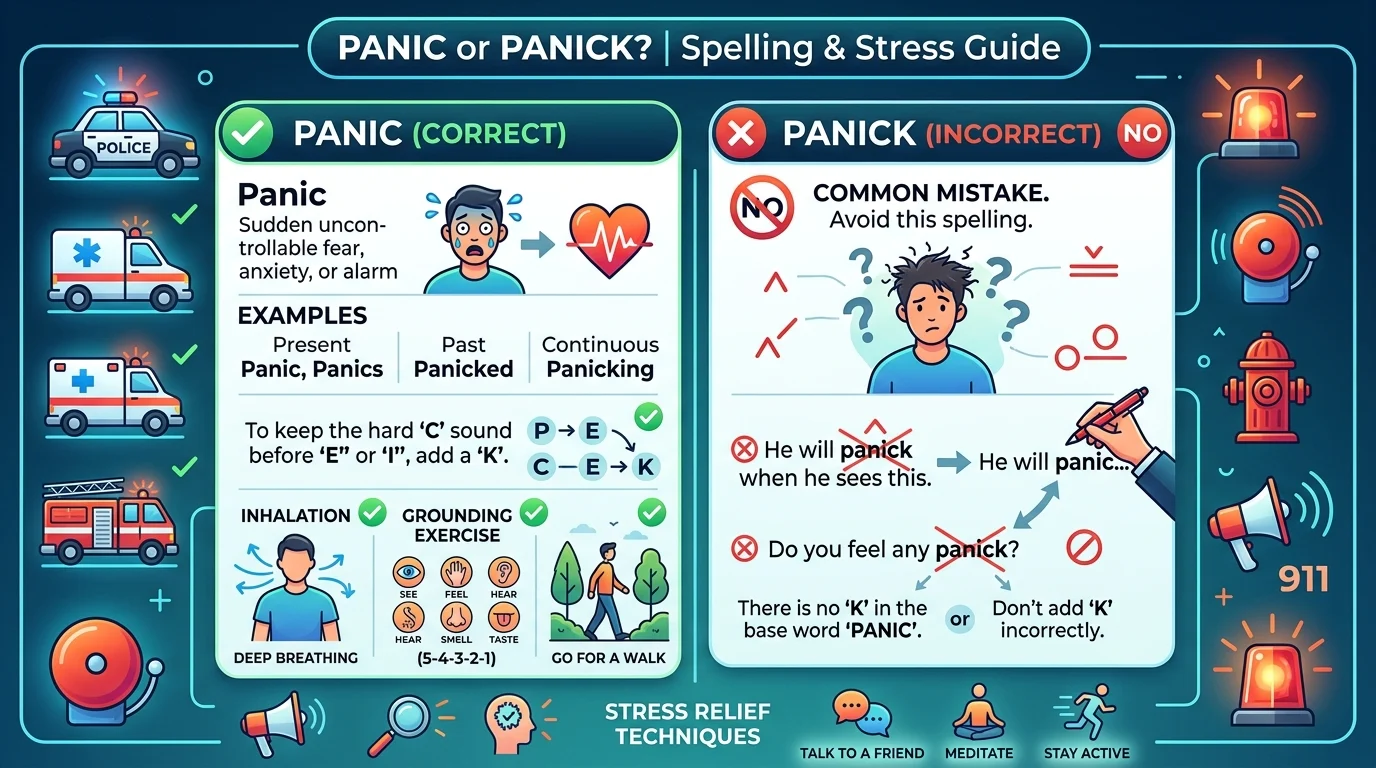
✅ Panic is the correct spelling.
❌ Panick is incorrect.
Correct example:
- “There was panic during the storm.”
Incorrect example:
- “There was panick during the storm.”
The word panic refers to:
- sudden fear
- extreme anxiety
- uncontrolled worry or alarm
What Does Panic Mean?
English Grammar Panic can function as both:
- a noun
- a verb
As a noun:
- it means sudden fear or alarm
As a verb:
- it means becoming frightened or anxious suddenly
Examples of Panic
- People began to panic during the emergency.
- The loud noise caused panic in the crowd.
- Don’t panic before the exam.
- Investors panicked after the market dropped.
Why “Panick” Is Incorrect
The spelling panick is not recognized in standard English dictionaries.
People often make this mistake because:
- many English words end in “ck”
- pronunciation may sound similar
- verbs like panic change spelling in some forms
However, the correct base word is always:
✅ panic
❌ panick
Panic vs Panick: Main Difference
| Word | Status | Meaning |
|---|---|---|
| Panic | Correct spelling | Sudden fear or anxiety |
| Panick | Incorrect spelling | Common typo |
Why the Confusion Happens
Linguistics The confusion often comes from verb forms like:
- panicked
- panicking
Notice how these forms add “k” before:
- -ed
- -ing
Examples
| Base Word | Correct Form |
|---|---|
| panic | panicked |
| panic | panicking |
The extra “k” appears only to preserve pronunciation in certain verb forms.
But the original word remains:
- panic
Common Uses of Panic
Health and Emotions
Psychology
- Panic attacks can feel overwhelming.
News and Emergencies
COVID-19 Pandemic
- Panic buying occurred during the pandemic.
Finance
Finance
- Investors panicked during market uncertainty.
Travel
Heathrow Airport
- Travelers panicked after flight delays.
Common Mistakes People Make
Mistake 1: Adding “K” to the Base Word
Incorrect:
- “Everyone felt panick.”
Correct:
- “Everyone felt panic.”
Mistake 2: Confusing Verb Forms
People see:
- panicked
- panicking
and mistakenly assume the base word is panick.
Mistake 3: Spelling by Sound
English pronunciation patterns sometimes create unnecessary letter additions.
Panic as a Verb
Examples
- Don’t panic during interviews.
- She panicked after losing her phone.
- Crowds were panicking during the emergency.
Panic in Common Phrases
Popular Expressions
- panic attack
- panic buying
- panic mode
- panic response
- widespread panic
Example Sentences
- The shortage caused panic buying.
- He went into panic mode before the presentation.
American vs British English Differences
Both:
- United States American English
- United Kingdom British English
use the same spelling:
✅ panic
❌ panick
There is no regional spelling difference.
Synonyms for Panic
Using related vocabulary improves readability and writing variety.
Common Synonyms
- fear
- alarm
- anxiety
- terror
- distress
- hysteria
Example
Instead of:
- “The news caused panic.”
You could say:
- “The news caused alarm.”
Why Correct Spelling Matters
Professional Communication Correct spelling improves:
- professionalism
- readability
- writing quality
- communication clarity
Misspellings like panick can distract readers and reduce credibility.
Easy Trick to Remember the Correct Spelling
A quick memory trick:
Panic Ends With “IC”
Think:
- musIC
- plastIC
- panIC
No “k” in the base word.
The “k” only appears in:
- panicked
- panicking
Related Word Forms
| Word Type | Example |
|---|---|
| Noun | panic |
| Verb | panic |
| Past tense | panicked |
| Present participle | panicking |
Example Sentence
- “She panicked during the panic situation.”
FAQs
Which spelling is correct: panic or panick?
Panic is the correct spelling.
Is panick a real word?
No. Panick is considered a spelling mistake.
Why do panicked and panicking use “k”?
The extra “k” preserves the correct pronunciation before adding “-ed” or “-ing.”
What does panic mean?
It means sudden fear, anxiety, or alarm.
Is panic a noun or a verb?
It can be both a noun and a verb.
Do British and American English spell panic differently?
No. Both use panic.
What is the past tense of panic?
The past tense is panicked.
Can spell-check detect panick?
Yes. Most spell-check tools suggest panic instead.
Final Summary
The difference between panic vs panick is simple once you understand the base-word spelling rule. Panic is the correct standard English spelling used for sudden fear or anxiety, while panick is an incorrect variation caused by confusion with forms like panicked and panicking.
Whenever you write about fear, stress, emergencies, or emotional reactions, always use panic without the extra “k.” Remembering that the “k” appears only in certain verb forms can help you avoid this common spelling mistake.
Actionable Takeaway
Before writing the word, remember:
- panic = base word
- no “k” at the end
So:
- panic ✅
- panick ❌
That quick spelling check will help you avoid the mistake every time.