Have you ever confused “inpatient” and “impatient”? You’re not alone. These words look almost identical, but they have completely different meanings. One is related to medical care, while the other describes someone who is unwilling to wait.
Understanding inpatient vs impatient is important because a single letter can completely change the meaning of your sentence. In this guide, you’ll learn the definitions, examples, common mistakes, American and British English differences, and an easy way to remember which word to use.
Quick Answer
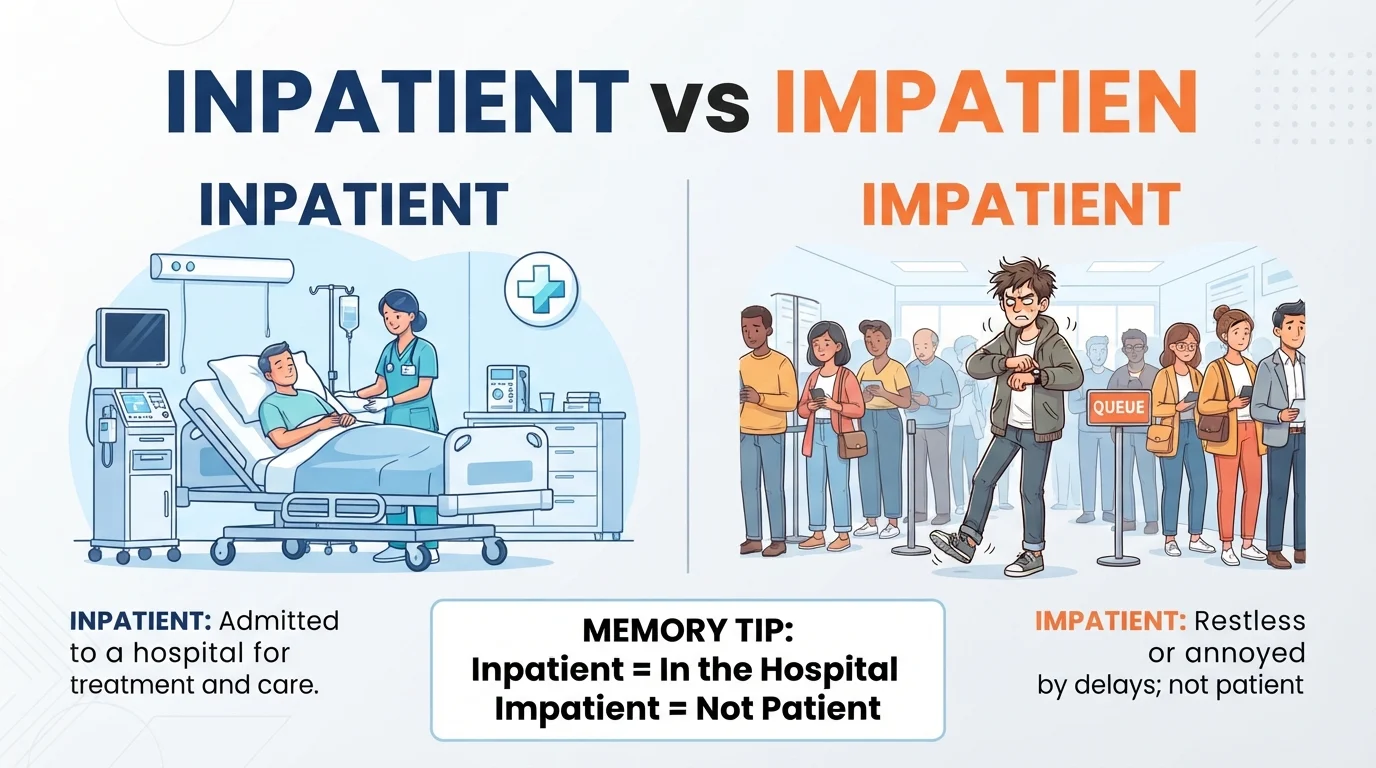
- Inpatient = A person receiving medical treatment while staying in a hospital or healthcare facility.
- Impatient = Unable or unwilling to wait calmly.
Examples:
- The hospital admitted the inpatient for treatment.
- She became impatient while waiting for the bus.
What Does “Inpatient” Mean?
Inpatient is a noun or adjective related to a person who stays in a hospital or healthcare facility while receiving medical treatment.
As a noun:
- The hospital admitted a new inpatient.
- The doctor examined the inpatient.
As an adjective:
- The patient requires inpatient care.
- He was transferred to an inpatient unit.
The opposite of inpatient is generally outpatient, someone who receives treatment without staying overnight in a hospital or facility.
What Does “Impatient” Mean?
Impatient is an adjective that describes someone who is unable or unwilling to wait calmly.
Examples:
- She became impatient while waiting in line.
- He is impatient for the results.
- The children were impatient to open their gifts.
- I am getting impatient because the bus is late.
Impatient can also mean eager for something to happen.
Example:
- She was impatient to begin her new job.
Inpatient vs Impatient
| Word | Meaning | Example |
|---|---|---|
| Inpatient | A person receiving treatment while staying in a hospital | The hospital admitted the inpatient. |
| Impatient | Unable or unwilling to wait calmly | He became impatient in the long line. |
The key difference is:
Inpatient = medical care and hospital stay
Impatient = unable to wait calmly
Common Mistakes
Mistake 1: Using “Inpatient” for Someone Who Cannot Wait
Incorrect:
- ❌ She is inpatient because the bus is late.
Correct:
- ✅ She is impatient because the bus is late.
Mistake 2: Using “Impatient” for Hospital Care
Incorrect:
- ❌ The doctor recommended impatient treatment.
Correct:
- ✅ The doctor recommended inpatient treatment.
Inpatient vs Outpatient
These terms are often used together in healthcare.
Inpatient
An inpatient stays in a hospital or medical facility while receiving treatment.
- The patient requires inpatient care.
Outpatient
An outpatient receives medical treatment but does not stay overnight.
- The procedure can be performed on an outpatient basis.
| Term | Meaning |
|---|---|
| Inpatient | Stays in a healthcare facility for treatment |
| Outpatient | Receives treatment without an overnight stay |
How to Remember the Difference
Look at the spelling:
Inpatient
In + patient
Think:
The patient is in the hospital.
Inpatient = in a medical facility
Impatient
Im + patient
Think:
The person is not patient.
Impatient = not willing to wait
This is a simple and effective memory trick.
American vs British English
The meanings of inpatient and impatient are the same in American and British English.
- Inpatient refers to hospital or residential medical care.
- Impatient describes someone who does not want to wait.
The spelling and basic usage do not significantly differ between the two varieties of English.
Examples in Everyday English
Inpatient
- The hospital has several inpatient rooms.
- The doctor recommended inpatient treatment.
- The inpatient was monitored overnight.
- The facility provides specialized inpatient care.
Impatient
- The customer became impatient after waiting for an hour.
- She was impatient to hear the results.
- Don’t be impatient; your turn will come soon.
- The children were impatient for the vacation to begin.
Tips to Avoid This Mistake
Follow these simple strategies:
- Use inpatient for hospital or residential medical care.
- Use impatient for someone who cannot wait calmly.
- Remember: inpatient = in the hospital.
- Remember: impatient = not patient.
- Check whether the sentence is about healthcare or waiting.
Frequently Asked Questions
What is the difference between inpatient and impatient?
Inpatient refers to someone receiving medical treatment while staying in a hospital or facility. Impatient describes someone who is unwilling or unable to wait calmly.
What is an inpatient?
An inpatient is a person who stays in a hospital or healthcare facility while receiving treatment.
What does impatient mean?
Impatient means unable or unwilling to wait calmly. It can also mean eager for something to happen.
Is inpatient the opposite of outpatient?
Generally, yes. An inpatient stays in a healthcare facility, while an outpatient receives treatment without staying overnight.
Is “impatient patient” correct?
Yes. These words have different meanings.
Example: The impatient patient was tired of waiting.
How can I remember inpatient vs impatient?
Think inpatient = in the hospital and impatient = not patient.
Do American and British English use these words differently?
No. The meanings and spellings are essentially the same in both varieties of English.
Summary
When comparing inpatient vs impatient, remember that inpatient is related to medical care and refers to someone who stays in a hospital or healthcare facility for treatment. Impatient, on the other hand, describes someone who cannot or does not want to wait calmly.
The easiest way to remember the difference is to break the words apart: inpatient = in + patient, meaning someone in a medical facility, while impatient = not patient, meaning someone who is unwilling to wait. One letter can completely change the meaning, so always check the context before choosing the word.
Actionable Takeaway
If the sentence is about hospital treatment or medical care, use inpatient. If it is about waiting, frustration, or eagerness, use impatient. Remember: inpatient = in the hospital; impatient = not patient.