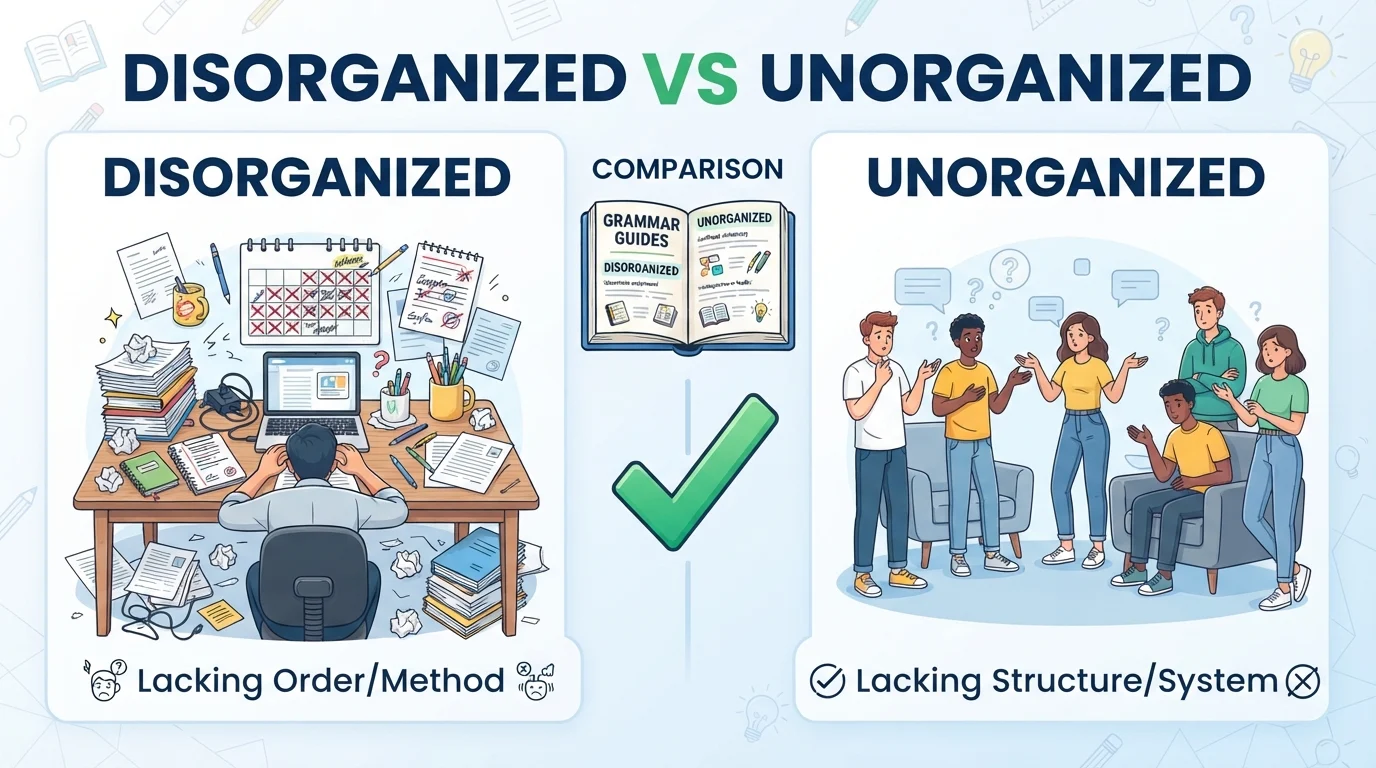
Have you ever wondered if to use “disorganized” or “unorganized”? You’re not alone. These two adjectives are closely related and can sometimes be used interchangeably, but they often have slightly different meanings and usage patterns.
In general, disorganized usually describes something that lacks order, structure, or organization, while unorganized can mean something that has not been organized or is not part of a formal organization. Understanding the difference between disorganized vs unorganized can help you choose the most natural word for your sentence.
Quick Answer
- Disorganized = Lacking order, structure, planning, or organization.
- Unorganized = Not organized or not belonging to an organized group.
Examples:
- My desk is disorganized.
- The files are unorganized.
- He is very disorganized.
- The workers were unorganized and had no formal association.
In many everyday situations, disorganized is the more natural choice.
What Does “Disorganized” Mean?
Disorganized means lacking order, planning, structure, or organization.
It can describe:
- a person
- a room
- a schedule
- a business
- a project
- information
- a system
Examples:
- My office is completely disorganized.
- She is often disorganized and forgets appointments.
- The meeting was disorganized.
- The company’s records were disorganized.
- His thoughts seemed disorganized.
The word often suggests that something should be organized but is not.
What Does “Unorganized” Mean?
Unorganized means not organized. It can describe something that has not been arranged or structured.
Examples:
- The documents were unorganized.
- The files remained unorganized.
- The group was unorganized and had no clear leadership.
Unorganized can also mean not belonging to a formal organization.
Example:
- The workers were unorganized and had no official union.
However, in everyday English, disorganized is often more natural when describing disorder or poor planning.
Disorganized vs Unorganized
| Word | Common Meaning | Example |
|---|---|---|
| Disorganized | Lacking order, structure, or planning | Her desk is disorganized. |
| Unorganized | Not organized or not part of a formal organization | The group was unorganized. |
The key difference is:
Disorganized = poorly arranged or lacking order
Unorganized = not organized or without formal organization
When to Use “Disorganized”
Use disorganized when something is messy, chaotic, poorly planned, or lacking structure.
Examples:
- The project became disorganized.
- He is extremely disorganized.
- The office looks disorganized.
- The event was poorly planned and disorganized.
- The information was presented in a disorganized way.
Disorganized Person
When describing someone’s habits or behavior, disorganized is usually the natural choice.
- She is very disorganized.
- He is disorganized at work.
- I can be disorganized when I have too many tasks.
When to Use “Unorganized”
Use unorganized when you simply mean that something has not been organized or does not belong to an organized group.
Examples:
- The files are still unorganized.
- The documents were left unorganized.
- The workers were unorganized.
- The group was unorganized and lacked formal leadership.
In some contexts, unorganized simply describes a neutral condition rather than active disorder.
Common Mistakes
One common mistake is assuming that unorganized and disorganized always mean exactly the same thing.
For example:
- The files are unorganized.
This may simply mean they have not yet been arranged. - The files are disorganized.
This suggests that the files are arranged poorly or are difficult to manage.
Another common mistake is using unorganized to describe a person when disorganized sounds more natural.
Less natural:
- He is very unorganized.
More natural:
- He is very disorganized.
Is “Unorganized” a Correct Word?
Yes. Unorganized is a valid English word.
However, its meaning and usage can differ slightly from disorganized.
Unorganized often means:
- not organized yet
- lacking formal organization
- not belonging to a structured group
Disorganized often suggests:
- disorder
- poor planning
- lack of structure
- confusion
- ineffective organization
American vs British English
Both disorganized and unorganized are used in American and British English.
However, disorganized is generally more common when describing:
- messy people
- messy spaces
- poor planning
- chaotic systems
In British English, you may also see the spelling:
- disorganised
- unorganised
The difference is simply the spelling of ize and ise.
Easy Trick to Remember
Think of the prefixes:
Disorganized = organization has broken down or is poor.
Unorganized = organization is absent or has not happened.
For example:
- A messy desk is disorganized.
- A group without a formal structure may be unorganized.
Related Words
Synonyms for disorganized include:
- messy
- chaotic
- disorderly
- confused
- scattered
- unstructured
- haphazard
Synonyms for unorganized include:
- unstructured
- informal
- unarranged
- unplanned
- independent
Tips to Avoid This Mistake
Follow these simple strategies:
- Use disorganized for messy, chaotic, or poorly planned situations.
- Use unorganized for something that has not been organized or lacks formal organization.
- Use disorganized to describe a person who struggles with organization.
- Remember that both words are correct, but the context determines the best choice.
- In everyday writing, disorganized is often the more natural option.
Frequently Asked Questions
What is the difference between disorganized and unorganized?
Disorganized usually means lacking order, structure, or planning, while unorganized can mean not organized or not belonging to a formal organization.
Is disorganized or unorganized better?
Neither word is always better. Disorganized is usually more natural for messy or chaotic situations, while unorganized may be better when something simply has not been organized.
Is “unorganized” a real word?
Yes. Unorganized is a correct English word.
Is it correct to say “I am unorganized”?
Yes, but “I am disorganized” is often more natural when describing a person’s difficulty with organization.
Can disorganized and unorganized be synonyms?
Yes, in some contexts they can be synonyms, especially when describing something that lacks order.
What is the British spelling of disorganized?
The British spelling is commonly disorganised.
What is the opposite of disorganized?
Common opposites include organized, orderly, structured, and well planned.
Summary
When comparing disorganized vs unorganized, both words are correct, but they often carry slightly different meanings. Disorganized usually describes something messy, chaotic, poorly planned, or lacking structure. Unorganized generally means that something has not been organized or does not belong to a formal organization.
For everyday situations, especially when describing a messy person, room, schedule, or project, disorganized is usually the more natural choice. Use unorganized when you want to emphasize the absence of organization or a lack of formal structure.
Actionable Takeaway
Use disorganized for messy, chaotic, or poorly planned situations, and use unorganized for something that is not organized or lacks formal organization. When describing a person or a messy situation, disorganized is usually the best choice.