Have you ever wondered whether to write “on to” as two words or “onto” as one word? You’re not alone. These two forms look nearly identical, but they can have different meanings and grammatical functions depending on the sentence.
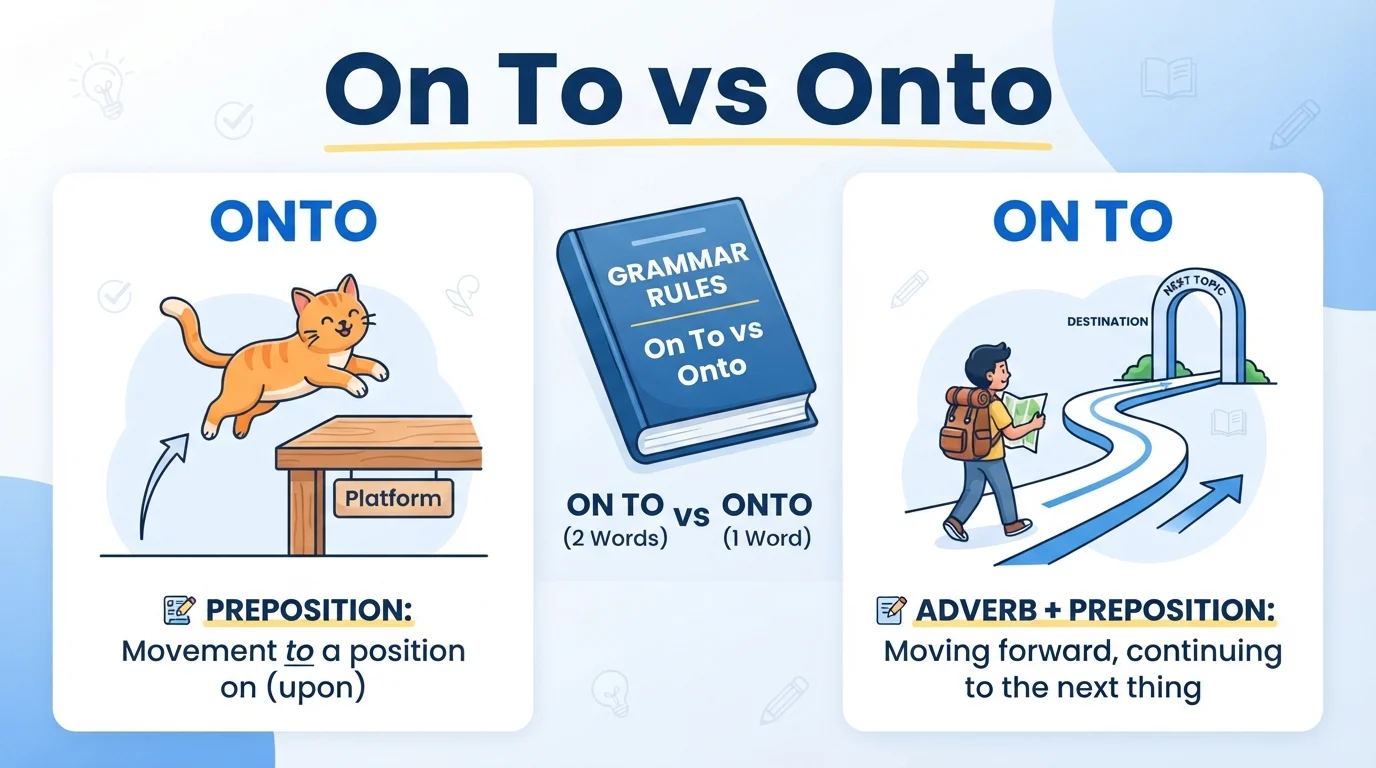
The correct choice depends on context. Onto is usually a preposition meaning “to a position on” or “to the top of.” On to is written as two words when on belongs to the first part of the sentence and to begins a separate phrase, often meaning moving forward to the next thing.
In this guide, you’ll learn the difference between on to vs onto, see clear examples, understand common mistakes, and discover an easy way to choose the correct form.
Quick Answer
Both on to and onto can be correct.
- Onto = Movement to a position on or toward the surface of something.
- On to = On and to function separately, often meaning moving forward to another subject, place, or activity.
Examples:
- The cat jumped onto the table.
- Let’s move on to the next topic.
What Does “Onto” Mean?
Onto is usually a preposition that describes movement to a position on or above something.
Examples:
- The child climbed onto the bed.
- She stepped onto the platform.
- The cat jumped onto the sofa.
- He placed the book onto the table.
A useful meaning is:
Onto = to a position on something
Movement Examples
- The bird flew onto the roof.
- The dog jumped onto the couch.
- She climbed onto the stage.
In each example, something moves toward or arrives at a position on a surface or place.
What Does “On To” Mean?
On to is written as two separate words when on and to have separate grammatical roles.
It is commonly used to mean:
- moving forward
- continuing to the next subject
- proceeding to another activity
- going to another place or person
Examples:
- Let’s move on to the next chapter.
- She went on to become a successful writer.
- After lunch, we moved on to the next activity.
On to vs Onto
| Form | Meaning | Example |
|---|---|---|
| Onto | Movement to a position on something | The cat jumped onto the table. |
| On to | Moving forward to another thing | Let’s move on to the next topic. |
The key difference is:
Onto = movement onto a surface or position
On to = continuing or moving forward to something else
How to Use “Onto” Correctly
Use onto when something moves to a position on a surface or object.
Examples:
- The child climbed onto the chair.
- The athlete stepped onto the field.
- The rabbit jumped onto the rock.
- The phone fell onto the floor.
“Onto” in a Figurative Sense
Onto can also mean discovering something or becoming aware of a secret.
Examples:
- I think she’s onto his plan.
- The police are onto the suspect.
- They realized we were onto their scheme.
Here, onto does not describe physical movement. It means aware of or investigating something.
How to Use “On To” Correctly
Use on to when on and to can be understood as separate words.
Moving to the Next Topic
- Let’s move on to the next question.
- We can now go on to the final section.
- The teacher moved on to a new lesson.
Continuing to Do Something
- She went on to win the competition.
- He went on to become a famous author.
- The team went on to achieve great success.
Common Mistakes
A common mistake is using onto when the sentence means moving forward to another subject.
Incorrect or less appropriate:
- ❌ Let’s move onto the next topic.
In many contexts, especially when referring to a new topic, the clearest choice is:
- ✅ Let’s move on to the next topic.
Another mistake is separating onto when it means movement to a surface.
Incorrect:
- ❌ The cat jumped on to the table.
Correct:
- ✅ The cat jumped onto the table.
A Simple Test
Try replacing the phrase with “to a position on.”
If the meaning still works, use onto.
Example:
- The cat jumped onto the table.
- The cat jumped to a position on the table. ✅
If the sentence means continue to the next thing, use on to.
Example:
- Let’s move on to the next topic.
- Let’s continue to the next topic. ✅
Easy Trick to Remember
Use this simple rule:
Onto = on a surface or position.
On to = moving forward to something else.
Examples:
- Jump onto the bed. (movement to a surface)
- Move on to the next lesson. (continuing forward)
American vs British English
Both American and British English use on to and onto.
However, usage preferences can sometimes vary, particularly in sentences involving movement or figurative expressions. In modern standard English, the context determines whether the words should be combined or separated.
The safest approach is to consider the meaning of the sentence rather than relying only on pronunciation.
Related Phrases
You may also encounter:
- move on to
- go on to
- step onto
- climb onto
- jump onto
- get onto
- be onto someone
- move forward to
- continue to
Examples:
- She went on to become a doctor.
- He stepped onto the stage.
- The detective was onto the suspect.
Tips to Avoid This Mistake
Follow these simple strategies:
- Use onto for movement to a surface or position.
- Use on to when meaning continue to the next thing.
- Try the replacement “to a position on” for physical movement.
- Look at the verb: jump onto, climb onto, and step onto usually describe physical movement.
- Use move on to and go on to when describing progress or continuation.
Frequently Asked Questions
Which is correct: on to or onto?
Both are correct, but they have different uses. Onto usually describes movement to a position on something, while on to often means continuing or moving forward to something else.
Is “move onto the next topic” correct?
It can be used, but move on to the next topic is often clearer and more traditional when you mean continuing to another topic.
Is “jump onto the bed” correct?
Yes. Jump onto the bed is correct because it describes movement to a position on the bed.
Is “go on to become” correct?
Yes. Go on to become is correct when describing what happens later or what someone does next.
Can “onto” be used figuratively?
Yes. For example, “The police are onto him” means the police are aware of or investigating him.
Do American and British English use “on to” and “onto” differently?
The basic rules are the same, although preferences can vary slightly in some contexts.
How can I remember the difference?
Use onto for movement to a surface or position. Use on to when moving forward to another topic, activity, or stage.
Summary
When comparing on to vs onto, both forms are correct, but the meaning determines which one you should use. Onto is generally used for movement to a position on or above something, as in “The cat jumped onto the table.” On to is used when on and to function separately, especially when someone continues or moves forward to another subject, activity, or stage.
The easiest way to remember the difference is to ask whether you mean “to a position on” something or “continue to the next thing.” Use onto for the first meaning and on to for the second.
Actionable Takeaway
Before choosing on to or onto, ask: Is something moving to a surface, or is someone moving forward to the next thing? Surface or position means onto; continuation or progression usually means on to.