Have you ever confused “patient” and “patience”? You’re not alone. These words look and sound similar because they come from the same word family, but they have different meanings and grammatical uses. Choosing the wrong one can make a sentence sound unnatural or completely change its meaning.
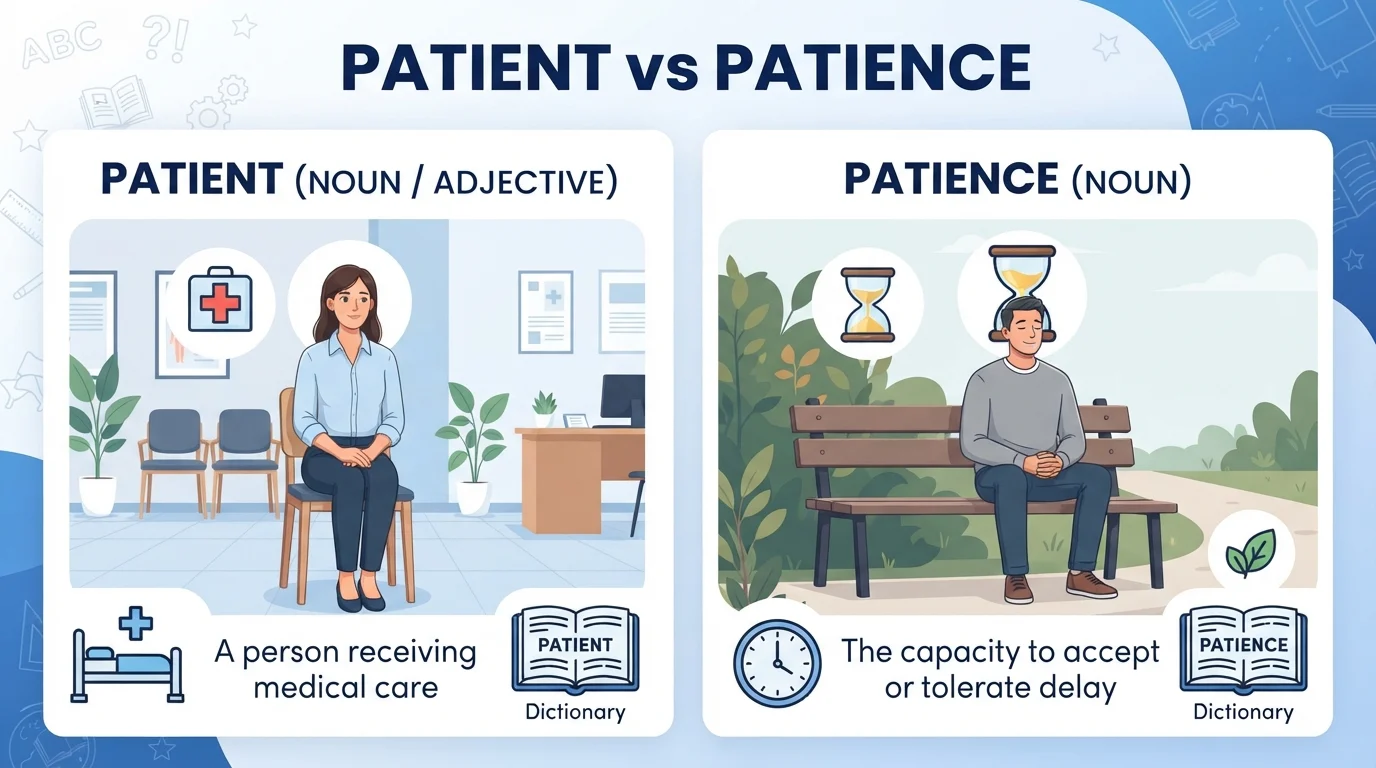
The simple rule is this: patient usually describes a person who can wait calmly, while patience is the ability to wait calmly without becoming frustrated. Patient can also mean a person receiving medical care. In this guide, you’ll learn the difference between patient vs patience, see clear examples, understand common mistakes, and discover an easy way to remember which word to use.
Quick Answer
- Patient = Able to wait calmly; or a person receiving medical treatment.
- Patience = The ability to remain calm while waiting or dealing with difficulties.
Examples:
- Please be patient.
- Thank you for your patience.
- The patient is waiting for the doctor.
What Does “Patient” Mean?
Patient has two main meanings.
Patient as an Adjective
As an adjective, patient describes someone who can wait calmly or tolerate difficult situations without becoming angry.
Examples:
- She is very patient with children.
- You need to be patient while learning a new skill.
- He was patient during the long delay.
Patient as a Noun
As a noun, patient means a person receiving medical care or treatment.
Examples:
- The doctor examined the patient.
- The patient is recovering well.
- The hospital admitted a new patient.
What Does “Patience” Mean?
Patience is a noun that means the ability to remain calm while waiting, dealing with problems, or tolerating difficult situations.
Examples:
- Learning a language requires patience.
- Thank you for your patience.
- She showed great patience with the children.
- My patience was tested during the long delay.
Patient vs Patience
| Word | Part of Speech | Meaning | Example |
|---|---|---|---|
| Patient | Adjective | Able to wait calmly | She is very patient. |
| Patient | Noun | A person receiving medical care | The patient needs rest. |
| Patience | Noun | The ability to wait calmly | He has a lot of patience. |
The key difference is:
Patient = describes a person
Patience = the quality or ability
How to Use “Patient” Correctly
Use patient when describing someone who is calm and willing to wait.
Examples:
- Be patient with yourself.
- She is a patient teacher.
- You must remain patient during the process.
- He was patient while waiting for an answer.
You can also use patient as a healthcare term:
- The patient visited the clinic.
- The nurse checked the patient.
How to Use “Patience” Correctly
Use patience when referring to the quality of staying calm.
Examples:
- You need patience to learn a musical instrument.
- Thank you for your patience.
- Her patience helped solve the problem.
- The situation tested everyone’s patience.
Common Phrase
One of the most common expressions is:
Thank you for your patience.
This is often used in:
- customer service
- emails
- announcements
- waiting situations
- technical support messages
Example:
Thank you for your patience while we resolve this issue.
Common Mistakes
One common mistake is using patience as an adjective.
Incorrect:
- ❌ Please be patience.
- ❌ She is very patience.
Correct:
- ✅ Please be patient.
- ✅ She is very patient.
Another mistake is using patient when you mean the quality of staying calm.
Incorrect:
- ❌ Thank you for your patient.
- ❌ Learning requires a lot of patient.
Correct:
- ✅ Thank you for your patience.
- ✅ Learning requires a lot of patience.
Easy Trick to Remember
Use this simple rule:
Patient = a person or a personality trait.
Patience = the quality of staying calm.
You can also remember:
- Patient = an adjective describing someone.
- Patience = a noun naming a quality.
Example:
- A patient person has patience.
This sentence helps connect the two words naturally.
American vs British English
There is no significant difference between American and British English in the spelling or meaning of patient and patience.
Both varieties use:
- patient for a calm person or someone receiving medical care
- patience for the ability to wait calmly
The words are spelled and used the same way in both varieties of English.
Related Words
Words related to patient and patience include:
- calm
- tolerant
- understanding
- composed
- peaceful
- endurance
- tolerance
- perseverance
- self-control
- persistence
These words can help you express similar ideas depending on the context.
Tips to Avoid This Mistake
Follow these simple tips:
- Use patient to describe a person.
- Use patience to describe the quality of staying calm.
- Remember: A patient person has patience.
- Use “Please be patient” when asking someone to wait calmly.
- Use “Thank you for your patience” when appreciating someone’s calm waiting.
Frequently Asked Questions
What is the difference between patient and patience?
Patient describes someone who can wait calmly, while patience is the ability or quality of waiting calmly.
Is “patient” an adjective or a noun?
It can be both. As an adjective, it means able to wait calmly. As a noun, it means a person receiving medical treatment.
Is “patience” a noun?
Yes. Patience is a noun that refers to the ability to remain calm while waiting or facing difficulties.
Which is correct: “Please be patient” or “Please be patience”?
Please be patient is correct.
Which is correct: “Thank you for your patient” or “Thank you for your patience”?
Thank you for your patience is correct.
Can a patient have patience?
Yes. A patient person can have patience.
Do American and British English use these words differently?
No. The spelling and basic meanings are the same in both varieties of English.
Summary
When comparing patient vs patience, remember that patient can describe someone who waits calmly, or it can refer to a person receiving medical treatment. Patience is the quality or ability to remain calm while waiting, facing delays, or dealing with difficult situations.
The easiest way to remember the difference is: a patient person has patience. Use patient when describing a person and patience when naming the quality. This simple rule will help you avoid common mistakes in everyday conversations, professional emails, customer service messages, and academic writing.
Actionable Takeaway
Before choosing patient or patience, ask yourself: Am I describing a person, or am I talking about the quality of staying calm? Use patient for the person and patience for the quality.