Have you ever wondered whether you should write goodmorning or good morning? It’s a common question because people often type greetings quickly in text messages, emails, and social media posts. While both forms may appear online, only one is considered correct in standard English.
If you’re searching for goodmorning vs good morning, you’ve come to the right place. This guide explains the correct spelling, provides real-life examples, highlights common mistakes, and shares simple memory tips to help you use this everyday greeting confidently.
Quick Answer
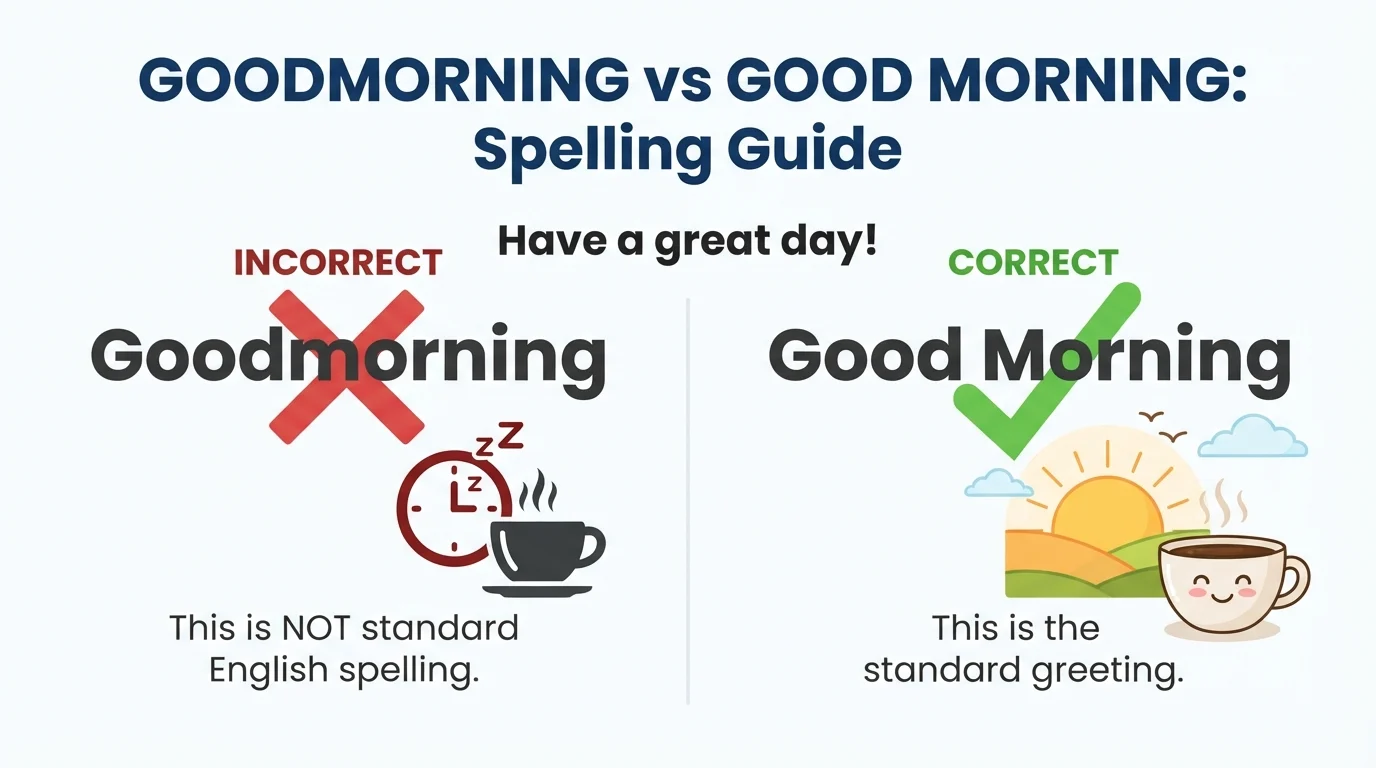
Good morning (two words) is the correct spelling.
Goodmorning (one word) is incorrect in standard English and should be avoided in formal and informal writing.
✅ Correct: Good morning! How are you today?
❌ Incorrect: Goodmorning! How are you today?
If you’re deciding between goodmorning vs good morning, always use good morning.
What Does Good Morning Mean?
Good morning is a common English greeting used to wish someone well during the morning hours. It is one of the most polite and widely recognized greetings in English-speaking countries.
People use it in conversations, emails, meetings, classrooms, workplaces, and everyday interactions.
Definition
Good morning (interjection): A polite greeting used when meeting or speaking to someone during the morning.
Examples of Good Morning
- Good morning, everyone!
- She smiled and said, “Good morning.”
- I send my parents a good morning message every day.
- Good morning, class. Let’s begin today’s lesson.
- He wished the customers a good morning as they entered the store.
Is Goodmorning a Real Word?
No. Goodmorning written as one word is not accepted in standard English dictionaries.
Although you may occasionally see goodmorning in social media hashtags, usernames, branding, or informal online posts, it is not the correct spelling in normal writing.
Always write it as two separate words:
Good morning ✅
Goodmorning vs Good Morning: Comparison Table
| Feature | Goodmorning | Good Morning |
|---|---|---|
| Correct English spelling | ❌ No | ✅ Yes |
| Found in standard dictionaries | ❌ No | ✅ Yes |
| Appropriate for formal writing | ❌ No | ✅ Yes |
| Suitable for emails | ❌ No | ✅ Yes |
| Standard greeting | ❌ No | ✅ Yes |
The comparison clearly shows that good morning is the correct choice.
Why Do People Write Goodmorning?
Several reasons explain this common mistake:
- Fast typing on phones and keyboards
- Autocorrect inconsistencies
- Influence of hashtags like #goodmorning
- Usernames and social media handles
- Assuming greetings should be written as one word
Although goodmorning appears online, it remains incorrect in standard English writing.
When to Use Good Morning
In Emails
Good morning, Sarah.
I hope you’re doing well.
At Work
- Good morning, everyone.
- Good morning, team.
In School
- Good morning, teacher.
- Good morning, students.
In Everyday Conversations
- Good morning! Did you sleep well?
- Good morning! Have a wonderful day.
Common Mistakes
Mistake 1: Writing Goodmorning as One Word
❌ Goodmorning everyone!
✅ Good morning, everyone!
Mistake 2: Forgetting the Comma
When directly addressing someone, include a comma.
❌ Good morning John.
✅ Good morning, John.
Mistake 3: Incorrect Capitalization
At the beginning of a sentence:
✅ Good morning!
In the middle of a sentence:
✅ She said good morning before leaving.
Easy Trick to Remember the Correct Spelling
A simple way to remember is this:
Think of good as an adjective describing the noun morning.
Just as you write:
- good day
- good evening
- good afternoon
You should also write:
- good morning
Since good and morning are separate words, they should never be combined into goodmorning.
American vs British English
There is no difference between American and British English.
Both use:
- Good morning
Neither variety accepts goodmorning as the standard spelling.
Example
Instead of writing:
- Good morning!
You could also say:
- Hello!
- Good day!
- Morning!
- Wishing you a wonderful morning!
Why Correct Spelling Matters
Using good morning instead of goodmorning helps you:
- Create a professional first impression
- Improve business communication
- Write polished emails
- Build reader trust
- Avoid grammar mistakes
- Improve readability and SEO
Even a simple greeting reflects your attention to detail, especially in professional and academic settings.
Frequently Asked Questions
Is goodmorning one word?
No. Goodmorning is not the correct spelling in standard English.
Which is correct: goodmorning or good morning?
Good morning is always the correct form.
Can I write goodmorning in an email?
No. In emails, business letters, and formal writing, always use good morning as two words.
Why do I see goodmorning on social media?
People often use goodmorning in hashtags, usernames, or informal posts, but it is not considered correct English spelling.
Is there a British and American spelling difference?
No. Both American and British English write it as good morning.
Should good morning be capitalized?
Capitalize Good only when it begins a sentence or is part of a title. Otherwise, use normal sentence capitalization.
Is “Morning!” acceptable as a greeting?
Yes. Morning! is a casual and widely accepted informal greeting, especially among friends, family, and coworkers.
Summary
The difference between goodmorning vs good morning is simple. Good morning is the correct spelling and should always be written as two separate words. Goodmorning is a common typo that appears in informal online spaces but is not accepted in standard English.
Whether you’re greeting someone in an email, classroom, workplace, or everyday conversation, always use good morning. This small detail makes your writing more professional, grammatically correct, and easier to read in both American and British English.
Actionable Takeaway
Before sending an email, publishing a blog post, or writing a message, check that you’ve written good morning as two separate words. This quick proofreading habit will help you communicate clearly and make a positive impression.