Losing someone is never easy, and when writing or speaking about death, it’s important to use respectful and grammatically correct language. One common question people ask is whether “past away” or “passed away” is the correct expression.
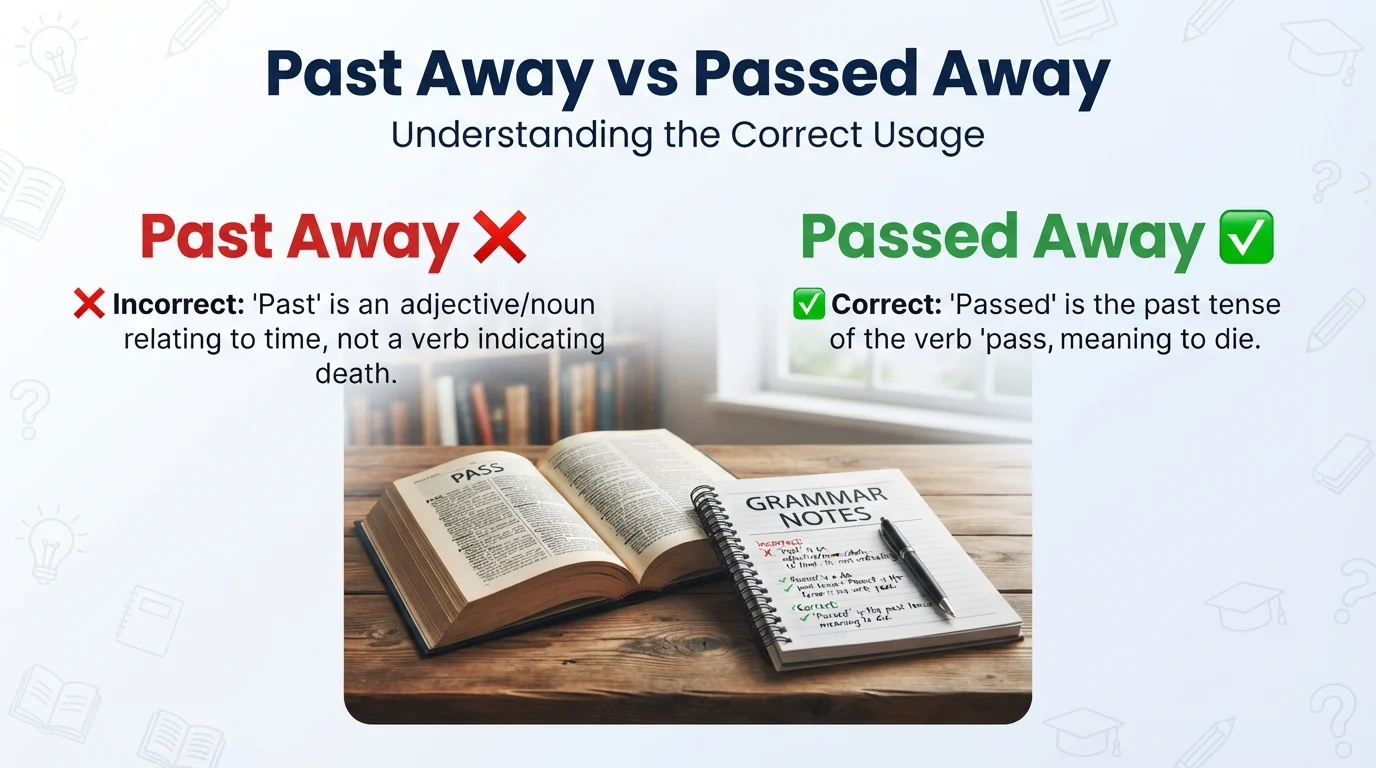
The answer is straightforward: “passed away” is the correct phrase, while “past away” is a common grammatical mistake. In this guide, you’ll learn the difference between past away vs passed away, understand why only one is correct, see real-life examples, and discover easy ways to remember the right usage.
Quick Answer
“Passed away” is correct.
“Past away” is incorrect in standard English.
- ✅ Passed away = A polite and respectful way to say someone has died.
- ❌ Past away = Grammatically incorrect.
Examples:
- ✅ Her grandfather passed away peacefully last night.
- ✅ We were saddened to hear that our neighbor passed away.
- ❌ Her grandfather past away last night.
What Does “Passed Away” Mean?
Passed away is a gentle and respectful expression used as a euphemism for “died.”
People often use it in conversations, obituaries, sympathy messages, and formal announcements because it sounds softer and more compassionate than saying someone “died.”
Examples:
- My aunt passed away after a long illness.
- His father passed away surrounded by family.
- We were deeply saddened when our teacher passed away.
Why “Past Away” Is Incorrect
The confusion comes from the words past and passed, which sound alike but have different meanings.
- Passed is the past tense of the verb “pass.”
- Past is usually a noun, adjective, adverb, or preposition referring to time or position.
Since the expression describes the action of someone passing, the correct verb form is passed.
Therefore:
- ✅ Passed away
- ❌ Past away
Past Away vs Passed Away
| Feature | Past Away | Passed Away |
|---|---|---|
| Correct spelling | ❌ No | ✅ Yes |
| Standard English | ❌ Incorrect | ✅ Correct |
| Grammatically correct | ❌ No | ✅ Yes |
| Used in formal writing | ❌ Never | ✅ Yes |
| Used in sympathy messages | ❌ No | ✅ Yes |
Whenever you’re deciding between past away vs passed away, always choose passed away.
Understanding “Past” vs “Passed”
Knowing the difference between these two words makes the rule easy.
| Word | Part of Speech | Meaning |
|---|---|---|
| Past | Noun, adjective, adverb, preposition | Refers to time or position |
| Passed | Verb (past tense of pass) | Means moved, went by, succeeded, or died (in the phrase passed away) |
Examples of past:
- We drove past the park.
- Let’s leave the past behind.
- It’s past midnight.
Examples of passed:
- She passed the exam.
- The train passed our station.
- His grandfather passed away peacefully.
Examples of “Passed Away” in Sentences
Family
- My grandmother passed away peacefully at home.
- His uncle passed away last week.
News
- The famous actor passed away at the age of 82.
- The community mourned after the local hero passed away.
Sympathy
- We are sorry to hear your father passed away.
- Our thoughts are with your family after your mother passed away.
Formal Announcements
- The company announced that its founder passed away on Monday.
- The organization honored its chairman, who recently passed away.
Common Mistakes
People often confuse past and passed because they sound identical.
Incorrect:
- ❌ She past away yesterday.
- ❌ My grandfather past away.
- ❌ He has past away.
Correct:
- ✅ She passed away yesterday.
- ✅ My grandfather passed away.
- ✅ He has passed away.
Easy Trick to Remember
A simple memory tip:
If you’re talking about an action, use passed because it’s a verb.
If you’re talking about time or direction, use past.
Think:
- Passed = Pass + -ed (an action)
- Past = Time or place
Since someone passes away, the correct phrase is passed away.
American vs British English
There is no difference between American and British English.
Both varieties use:
- ✅ Passed away
- ❌ Past away
The expression is standard and widely accepted in both forms of English.
Related Expressions
Depending on the context, you may also hear:
- died
- deceased
- departed
- lost their life
- no longer with us
- gone peacefully
- departed this life
Among these, passed away is one of the most respectful and commonly used expressions.
Tips to Avoid This Mistake
Follow these simple tips:
- Remember that passed is the verb.
- Use passed away whenever referring to someone’s death.
- Reserve past for time or location.
- Proofread sympathy messages carefully.
- Think of the phrase “passed the exam”—the same verb is used in passed away.
Frequently Asked Questions
Is “past away” correct?
No. Past away is grammatically incorrect.
Which is correct: past away or passed away?
Passed away is the correct expression.
Why do people write “past away”?
Because past and passed sound the same in English, many people accidentally choose the wrong spelling.
What does “passed away” mean?
It is a polite and respectful way of saying someone has died.
Is “passed away” appropriate in formal writing?
Yes. It is commonly used in obituaries, announcements, condolences, and formal communication.
Do American and British English both use “passed away”?
Yes. Both American and British English use passed away.
Can I use “passed away” in a sympathy message?
Yes. It is one of the most respectful and compassionate expressions to use when offering condolences.
Summary
When comparing past away vs passed away, the correct phrase is always passed away. The word passed is the past tense of the verb pass, making it the only grammatically correct choice in this expression. Past away is a common spelling mistake caused by the similar pronunciation of past and passed.
If you’re writing a sympathy card, obituary, email, or personal message, using passed away shows both grammatical accuracy and respect. Remember the simple rule: if it’s an action, use “passed”; if it’s about time or position, use “past.”
Actionable Takeaway
Before sending any message about someone’s death, quickly check the phrase. If you’ve written “past away,” replace it with “passed away.” This small correction ensures your writing is both respectful and grammatically correct.