Have you ever typed “studing” and wondered if it was correct? You’re not alone. Many English learners and even native speakers occasionally misspell studying because English spelling rules can be tricky, especially when adding -ing to verbs.
The good news is that the rule is easy to remember. In this guide, you’ll learn the difference between studing vs studying, discover the correct spelling, understand why the mistake happens, and see plenty of examples to help you avoid it in the future.
Quick Answer
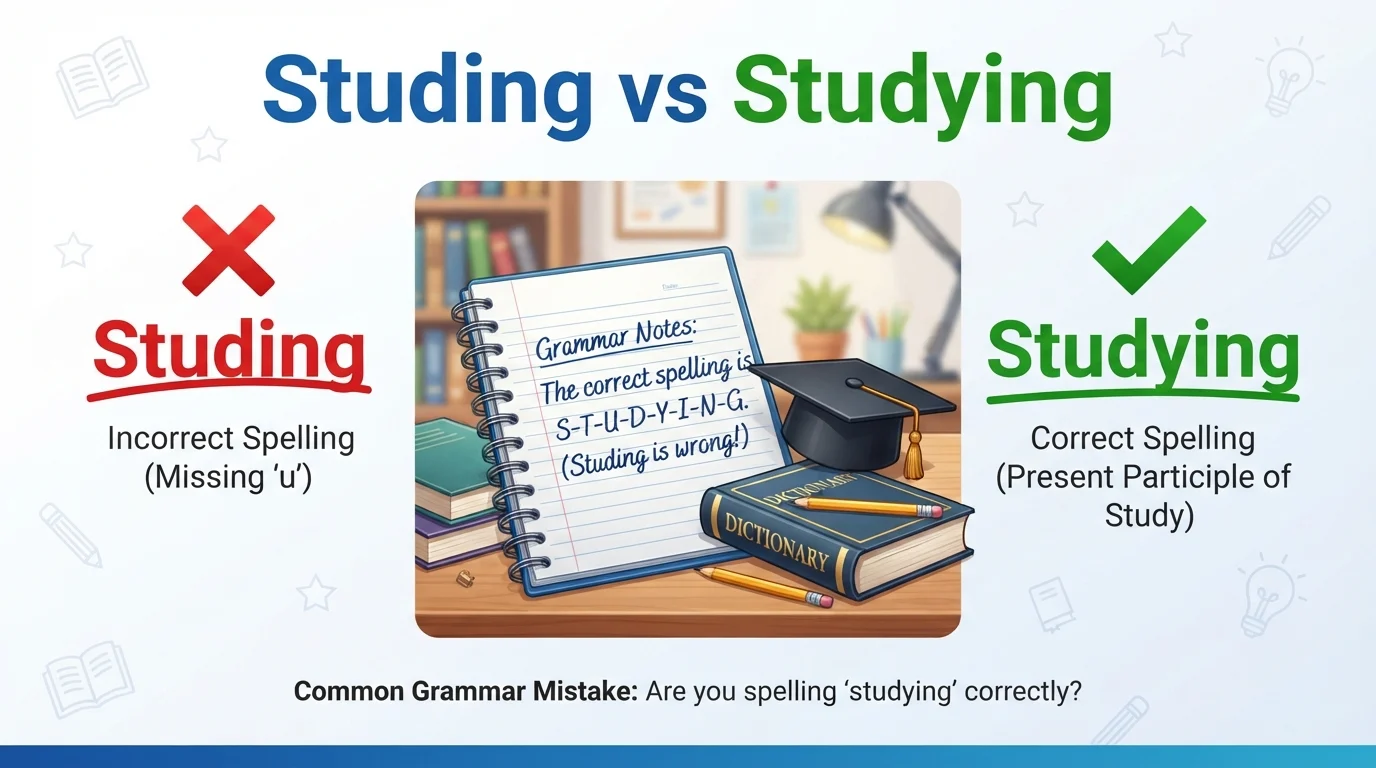
“Studying” is correct.
“Studing” is incorrect in standard English.
- ✅ Studying = Correct present participle and gerund form of study
- ❌ Studing = Incorrect spelling
Examples:
- ✅ I am studying for my final exams.
- ✅ She enjoys studying English every evening.
- ❌ I am studing for my exams.
What Does “Studying” Mean?
Studying is the -ing form of the verb study, which means to learn about a subject by reading, practicing, researching, or attending classes.
It can function as either:
- A present participle (used with helping verbs)
- A gerund (used as a noun)
Examples:
Present participle:
- They are studying mathematics.
Gerund:
- Studying every day improves your grades.
Why “Studing” Is Incorrect
The verb study ends with a consonant + y.
When adding -ing, you keep the letter “y” and simply add -ing.
Correct formation:
Study → Studying
Not:
Study → Studing ❌
The y is never removed when forming the -ing version.
Studing vs Studying
| Feature | Studing | Studying |
|---|---|---|
| Correct spelling | ❌ No | ✅ Yes |
| Standard English | ❌ Incorrect | ✅ Correct |
| Dictionary recognized | ❌ No | ✅ Yes |
| Used in formal writing | ❌ Never | ✅ Yes |
| Used in everyday English | ❌ No | ✅ Yes |
Whenever you’re choosing between studing vs studying, always write studying.
Understanding the Verb “Study”
Here are the main forms of the verb:
| Verb Form | Word |
|---|---|
| Base Form | Study |
| Third Person Singular | Studies |
| Past Tense | Studied |
| Past Participle | Studied |
| Present Participle | Studying |
Examples:
- I study English every day.
- She studies science.
- We studied for the test yesterday.
- They have studied hard this semester.
- I am studying now.
Why the “Y” Stays
Many learners confuse spelling rules involving words ending in y.
Here’s the rule:
When adding -ing, do not remove the “y.”
Examples:
| Base Verb | Correct -ing Form |
|---|---|
| Study | Studying |
| Carry | Carrying |
| Cry | Crying |
| Try | Trying |
| Hurry | Hurrying |
The y remains in every case.
Examples of “Studying” in Sentences
School
- She is studying biology at university.
- The students are studying for tomorrow’s exam.
Work
- I’m studying a new software program.
- Our team is studying customer feedback.
Everyday Life
- He spends two hours studying every evening.
- They are studying different languages.
Online Learning
- Millions of people are studying through online courses.
- She enjoys studying from home.
Common Mistakes
Here are mistakes people often make.
Incorrect:
- ❌ I am studing English.
- ❌ She likes studing history.
- ❌ We were studing yesterday.
Correct:
- ✅ I am studying English.
- ✅ She likes studying history.
- ✅ We were studying yesterday.
Easy Trick to Remember
Think about the original word:
Study
The y stays.
Simply add -ing:
Study → Studying
A helpful memory tip:
If the word ends in “y,” keep the “y” before adding “-ing.”
American vs British English
There is no difference between American and British English.
Both use:
- ✅ Studying
- ❌ Studing
The spelling rule is exactly the same in both varieties of English.
Tips to Avoid This Mistake
Use these simple tips:
- Remember that study keeps its y when adding -ing.
- Read your writing aloud and look for common spelling errors.
- Practice writing sentences with studying.
- Use spell-check tools, but learn the rule so you can spot mistakes yourself.
- Proofread emails, assignments, and social media posts before publishing.
Frequently Asked Questions
Is “studing” a real English word?
No. Studing is not recognized as a correct English spelling.
Which is correct: studing or studying?
Studying is the correct spelling.
Why is there a “y” in studying?
Because verbs ending in y keep the y when adding -ing.
What is the present participle of “study”?
The present participle is studying.
Example:
- I am studying for my exams.
Is “studying” a verb or a noun?
It can be both.
As a verb:
- They are studying French.
As a gerund (noun):
- Studying requires discipline.
Do American and British English spell it differently?
No. Both spell it studying.
What is the past tense of “study”?
The past tense is studied.
Example:
- She studied all weekend.
Summary
When comparing studing vs studying, the correct spelling is always studying. The word studing is a common spelling mistake because some writers incorrectly remove the y before adding -ing. However, English grammar requires you to keep the y, making studying the only correct form.
If you’re writing an essay, sending an email, or updating your résumé, using studying correctly will make your writing more accurate and professional. Remember the simple rule: Study → Studying. Keeping the y every time will help you avoid this common error.
Actionable Takeaway
Whenever you add -ing to study, keep the y and write studying. A quick proofreading check for this common spelling mistake can instantly improve the quality of your writing.