The confusion between storys or stories is a very common English grammar mistake. Since many nouns become plural by simply adding “s,” some people assume that story becomes storys. However, English plural rules work differently for words ending in -y.
If you’ve ever wondered whether to write storys or stories in essays, books, emails, or everyday writing, this guide explains the correct spelling, grammar rules, meanings, examples, and easy memory tricks to help you use the right form confidently.
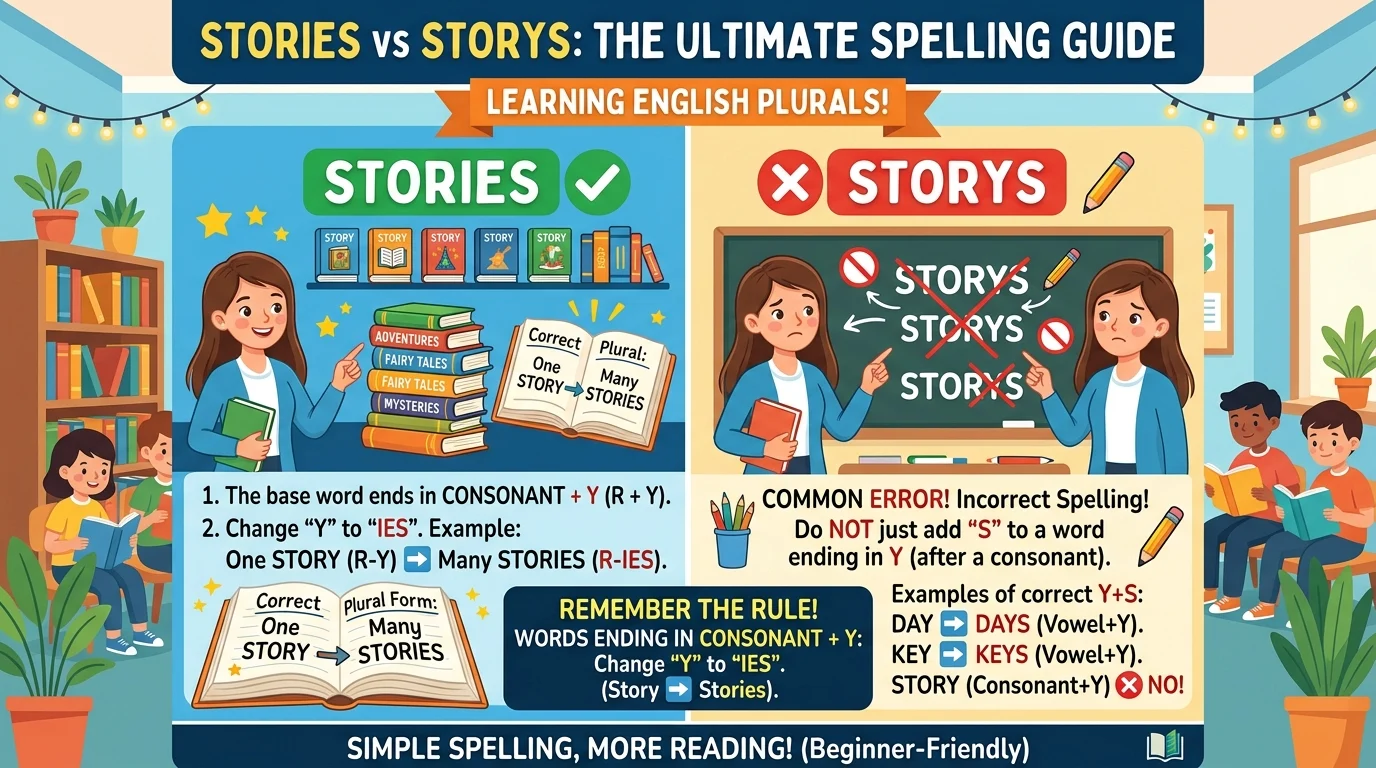
Quick Answer
✅ Stories is the correct spelling.
❌ Storys is incorrect.
Correct example:
- “She enjoys reading mystery stories.”
Incorrect example:
- “She enjoys reading mystery storys.”
The word stories is the plural form of story.
What Does Stories Mean?
English Grammar Stories refers to:
- multiple narratives
- tales
- accounts
- fictional or real events
Examples of Stories
- Children love bedtime stories.
- The magazine published inspiring stories.
- Grandparents often share family stories.
- Adventure stories remain very popular.
Why “Stories” Is Correct
The singular noun is:
- story
When a noun ends in:
- consonant + y
English grammar usually changes:
- y → ies
So:
- story → stories
Not:
- storys
The Grammar Rule Behind Stories
Linguistics English pluralization rules state:
If a noun ends with:
- consonant + y
then:
- remove the “y”
- add “ies”
Examples
| Singular | Correct Plural |
|---|---|
| story | stories |
| city | cities |
| country | countries |
| baby | babies |
Storys vs Stories: Main Difference
| Word | Status | Meaning |
|---|---|---|
| Stories | Correct spelling | More than one story |
| Storys | Incorrect spelling | Common grammar mistake |
Why People Write “Storys”
Many writers make this mistake because:
- most English plurals simply add “s”
- plural rules can seem inconsistent
- fast typing causes spelling errors
However, words ending in consonant + y follow the “ies” rule.
Common Uses of Stories
Literature
Literature
- Short stories are popular worldwide.
Media
Netflix
- Streaming platforms feature stories from many cultures.
Childhood Learning
Education
- Teachers read stories to children.
Journalism
Journalism
- Newspapers publish breaking stories every day.
Common Mistakes People Make
Mistake 1: Adding Only “S”
Incorrect:
- “I enjoy fantasy storys.”
Correct:
- “I enjoy fantasy stories.”
Mistake 2: Forgetting the “Y to IES” Rule
Writers sometimes forget that consonant + y changes in plural form.
Mistake 3: Fast Typing Errors
Typing quickly often causes small grammar mistakes.
Singular vs Plural Form
| Singular | Plural |
|---|---|
| story | stories |
Example Sentence
- One story
- Many stories
Story as More Than One Meaning
The word story can mean:
- a narrative
- a level in a building
Examples
- She wrote several stories.
- The apartment building has three stories.
Similar Words Following the Same Rule
| Singular | Plural |
|---|---|
| family | families |
| library | libraries |
| company | companies |
| party | parties |
Exceptions to the Rule
If a word ends in:
- vowel + y
you usually add only “s.”
Examples
| Singular | Plural |
|---|---|
| toy | toys |
| key | keys |
| boy | boys |
Because story ends with:
- consonant + y
the correct plural becomes:
- stories
American vs British English Differences
Both:
- United States American English
- United Kingdom British English
use the same spelling:
✅ stories
❌ storys
There is no regional spelling difference.
Synonyms for Stories
Using related vocabulary improves readability and writing variety.
Common Synonyms
- tales
- narratives
- accounts
- reports
- anecdotes
Example
Instead of:
- “Interesting stories”
You could say:
- “Interesting narratives”
Why Correct Spelling Matters
Professional Communication Correct spelling improves:
- readability
- professionalism
- academic quality
- communication clarity
Mistakes like storys can distract readers and weaken writing credibility.
Easy Trick to Remember the Correct Spelling
A simple memory trick:
Story Ends With Consonant + Y
So:
- remove “y”
- add “ies”
Think:
- story → stories
Just like:
- city → cities
Related Word Forms
| Word Type | Example |
|---|---|
| Singular noun | story |
| Plural noun | stories |
| Adjective | story-based |
| Related noun | storyteller |
Example Sentence
- “Storytellers shared inspiring stories.”
FAQs
Which spelling is correct: storys or stories?
Stories is the correct spelling.
Why is storys incorrect?
Because nouns ending in consonant + y usually change “y” to “ies” in plural form.
What does stories mean?
It means more than one story, narrative, or account.
What is the singular form of stories?
The singular form is story.
Do British and American English spell stories differently?
No. Both use stories.
What grammar rule does story follow?
It follows the consonant + y → ies plural rule.
Is storys a real word?
No. Storys is considered a spelling mistake.
Can spell-check detect storys?
Yes. Most spell-check tools suggest stories instead.
Final Summary
The difference between storys or stories becomes simple once you understand English plural rules. Stories is the correct plural form of story because nouns ending in consonant + y change the “y” to “ies.” The spelling storys is incorrect and usually appears because writers mistakenly add only “s.”
Whenever you write about multiple narratives, tales, or reports, always use stories. Remembering the “y to ies” rule can help you avoid this common grammar mistake and improve your writing accuracy.
Actionable Takeaway
Before writing the plural form, remember:
- story → stories
- consonant + y = ies
So:
- stories ✅
- storys ❌
That quick grammar check will help you avoid the mistake every time.