Have you ever wondered whether you should write “anyway” or “anyways”? You’re not alone. Both forms appear frequently in conversations, text messages, social media, and informal writing, but they are not used in exactly the same way.
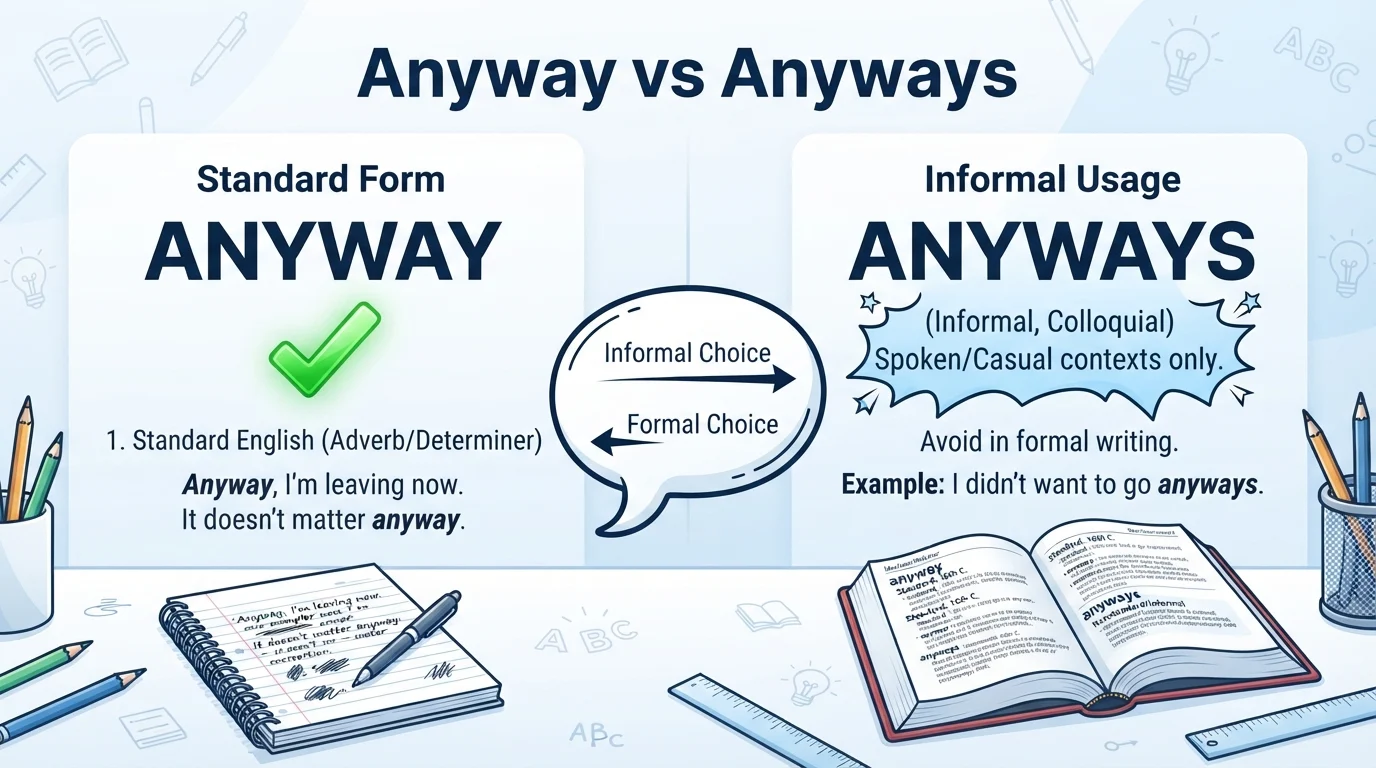
The standard and widely accepted form is anyway. Anyways is also used, especially in informal American English and casual speech, but many style guides consider it nonstandard or less formal.
In this guide, you’ll learn the difference between anyway vs anyways, understand their meanings, see clear examples, explore American and British English differences, and learn which form is best for professional writing.
Quick Answer
- ✅ Anyway = The standard form used in formal and informal English.
- ⚠️ Anyways = Common in casual speech and informal American English, but often considered nonstandard.
- For professional or academic writing, choose “anyway.”
Examples:
- Anyway, let’s continue with the meeting.
- I didn’t want to go, but I went anyway.
- Anyways, what were you saying? (informal/casual)
What Does “Anyway” Mean?
Anyway is an adverb with several common meanings.
“Anyway” Meaning “Regardless”
It can mean despite something, regardless, or in spite of that.
Examples:
- It was raining, but we went anyway.
- I was tired, but I finished the project anyway.
- She knew it would be difficult, but she tried anyway.
“Anyway” Meaning “In Any Case”
Anyway can also be used to move a conversation forward or return to the main topic.
Examples:
- Anyway, let’s get back to the main subject.
- Anyway, what happened next?
- Anyway, I need to leave now.
“Anyway” Meaning “At Least”
Sometimes anyway can mean at least or in any event.
Example:
- I didn’t win, but I enjoyed the experience anyway.
What Does “Anyways” Mean?
Anyways is an informal variant of anyway. It is common in casual conversation, regional speech, texting, and informal online communication.
Examples:
- Anyways, what are you doing later?
- I wasn’t sure it would work, but I tried anyways.
However, anyways is generally less suitable for:
- academic writing
- business reports
- formal emails
- professional documents
- formal essays
For these situations, anyway is the safer and more standard choice.
Anyway vs Anyways
| Word | Standard English | Formal Writing | Common Use |
|---|---|---|---|
| Anyway | ✅ Yes | ✅ Yes | All types of writing and speech |
| Anyways | ⚠️ Informal/nonstandard in some styles | ❌ Usually avoided | Casual speech and informal writing |
The key difference is:
Anyway = standard and widely accepted
Anyways = informal and often considered nonstandard
How to Use “Anyway” Correctly
To Change the Subject
- Anyway, let’s talk about something else.
- Anyway, I have an important question.
To Return to the Main Topic
- Anyway, where were we?
- Anyway, let’s get back to work.
To Show “Regardless”
- I was nervous, but I did it anyway.
- He didn’t agree, but he helped us anyway.
To End a Conversation
- Anyway, I should get going.
- Anyway, I’ll talk to you later.
How to Use “Anyways” Correctly
Anyways is mainly used in casual, conversational English.
Examples:
- Anyways, let’s move on.
- I didn’t really like it, but I watched it anyways.
- Anyways, what were you saying?
While these examples are common in casual speech, anyway is usually the better choice in polished writing.
Common Mistakes
One common mistake is using anyways in formal writing.
Less suitable:
- ⚠️ Anyways, the report shows significant improvement.
Better:
- ✅ Anyway, the report shows significant improvement.
Another mistake is assuming anyways is always grammatically wrong. It is widely used in informal speech and is understood by English speakers, but it is less formal and may be considered nonstandard depending on the style guide or dialect.
Is “Anyways” Wrong?
Not necessarily.
Anyways is a real word used in informal English, particularly in some varieties of American English. However, anyway is the standard form and is accepted in virtually every context.
A good rule is:
- Formal writing → Use anyway.
- Professional communication → Use anyway.
- Academic writing → Use anyway.
- Casual conversation → Either may be heard, but anyway is still the safest choice.
- Dialogue or creative writing → Anyways may be appropriate if you want to reflect natural speech.
American vs British English
Anyway is standard in both American and British English.
Anyways is more commonly associated with informal American speech and some regional varieties. It may also appear in informal British usage, but anyway remains the standard form in both varieties.
Examples:
- American English: Anyway, let’s go.
- British English: Anyway, let’s go.
The standard spelling is the same.
Related Words and Expressions
You can often replace anyway with:
- regardless
- in any case
- nevertheless
- nonetheless
- anyhow
- at any rate
- despite that
Examples:
- It was difficult, but we continued anyway.
- It was difficult, but we continued nevertheless.
- In any case, we decided to continue.
Anyhow is also similar to anyway and is generally accepted in informal and standard English.
Tips to Avoid This Mistake
Follow these simple strategies:
- Use anyway as your default choice.
- Use anyways mainly in casual speech or informal writing.
- Avoid anyways in academic and professional writing.
- Remember that anyway is accepted in every major English variety.
- If you’re unsure, choose anyway.
Frequently Asked Questions
Which is correct: anyway or anyways?
Anyway is the standard form. Anyways is commonly used informally but is often considered less formal or nonstandard.
Is “anyways” grammatically wrong?
Not always. It is widely used in informal speech and writing, but anyway is the standard form preferred in formal English.
Can I use “anyways” in an email?
You can use it in a very casual personal email, but anyway is better for professional or formal emails.
Which is better for academic writing: anyway or anyways?
Use anyway. It is the standard form and is more appropriate for academic writing.
Do Americans say “anyways”?
Yes. Anyways is common in informal American English, especially in casual conversation and regional speech.
Do British people use “anyways”?
It can be heard in informal British English, but anyway is the standard and more widely accepted form.
Is “anyway” one word?
Yes. Anyway is written as one word.
Summary
When comparing anyway vs anyways, anyway is the standard form and the safest choice in all types of English writing. It can mean regardless, in any case, or can be used to change the subject or return to a previous topic. Anyways is also used, especially in casual speech and informal American English, but it is generally less suitable for formal or professional writing.
The easiest rule to remember is: when in doubt, use anyway. It works in conversations, emails, essays, reports, and professional documents. Use anyways only when a very casual tone or natural conversational style is intended.
Actionable Takeaway
Before submitting formal writing, replace anyways with anyway unless you’re intentionally writing informal dialogue or casual speech. This simple choice will make your writing sound more polished and standard.