Have you ever wondered if you should write costumer or customer? You’re not alone. These two words look almost identical, but they have completely different meanings. Because they differ by only one letter, many people accidentally use the wrong one in emails, blog posts, business documents, and even social media.
If you’ve been searching for costumer vs customer, this guide will explain the difference in simple language. You’ll learn what each word means, when to use it, common mistakes to avoid, practical examples, and an easy trick to remember the correct spelling.
Quick Answer
The words costumer and customer are both correct English words, but they have different meanings.
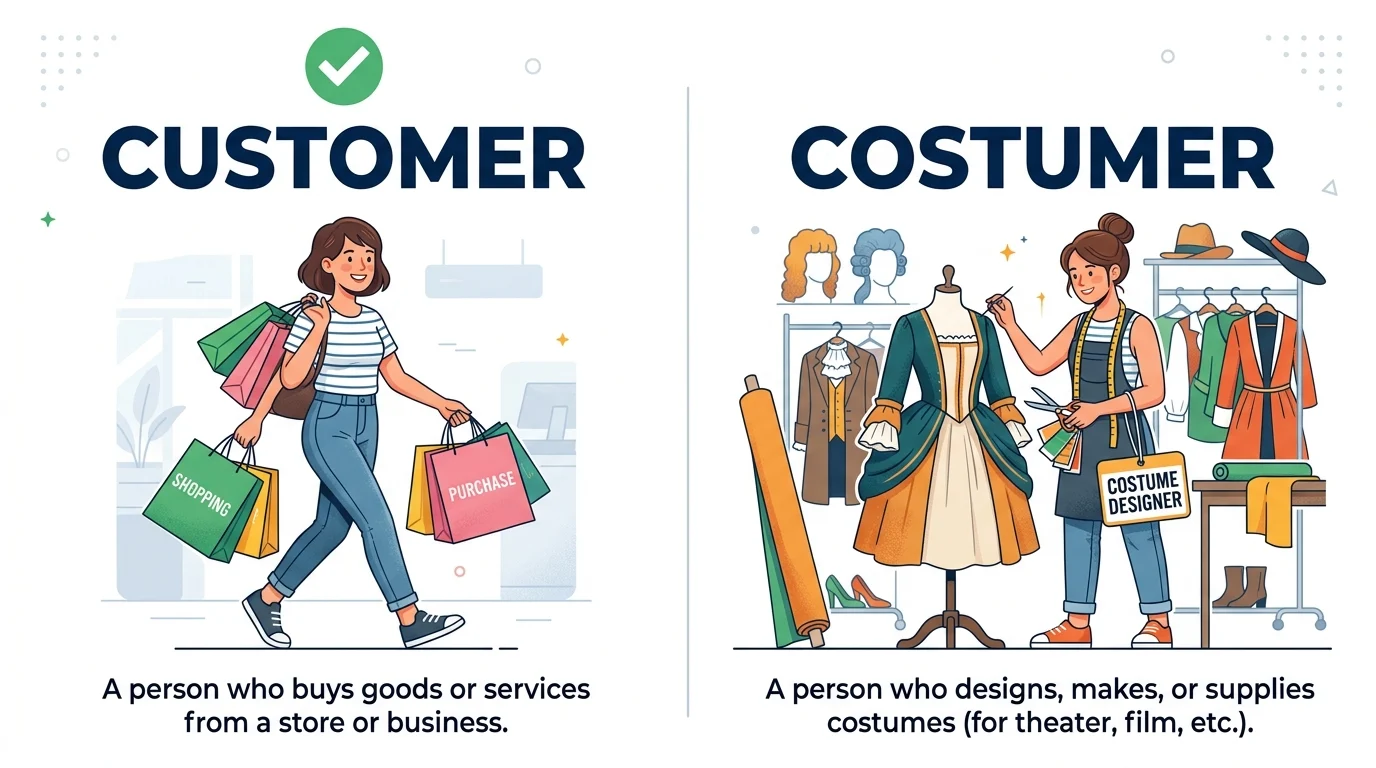
- Customer = A person who buys goods or services.
- Costumer = A person who makes, rents, or sells costumes, or someone who wears a costume.
Most of the time, if you’re talking about shopping, businesses, or clients, the correct word is customer.
What Does Customer Mean?
A customer is someone who purchases products or services from a business.
It is one of the most commonly used words in business, retail, marketing, and customer service.
Definition
Customer (noun): A person or organization that buys goods or services.
Examples of Customer
- The customer was happy with the service.
- Every customer receives a discount coupon.
- Our online store values every customer.
- The customer left a positive review.
- Customer satisfaction is our top priority.
What Does Costumer Mean?
A costumer is someone who designs, makes, rents, or supplies costumes. The word may also refer to someone who wears a costume, depending on the context.
It is commonly used in theatre, film, television, fashion, cosplay, and Halloween events.
Definition
Costumer (noun): A person who creates, sells, rents, or wears costumes.
Examples of Costumer
- The costumer prepared outfits for the theatre production.
- Every actor met with the costumer before rehearsals.
- The movie hired an experienced costumer.
- The Halloween store employed several costumers.
- The costumer designed historical clothing for the play.
Costumer vs Customer: Comparison Table
| Feature | Costumer | Customer |
|---|---|---|
| Meaning | A person who makes or wears costumes | A person who buys goods or services |
| Common Industry | Theatre, film, fashion, cosplay | Retail, business, e-commerce |
| Used in everyday shopping | ❌ Rarely | ✅ Yes |
| Refers to buyers | ❌ No | ✅ Yes |
| Refers to costumes | ✅ Yes | ❌ No |
The easiest way to remember the difference is that customer relates to buying products, while costumer relates to costumes.
Why People Confuse Costumer and Customer
These words are often confused because:
- They differ by only one letter.
- Their pronunciation is very similar.
- Spell-check tools may not catch the mistake because both are real English words.
- Fast typing often leads to accidental errors.
Although both words are correct, using the wrong one changes the meaning of your sentence.
Common Mistakes
Mistake 1: Using Costumer Instead of Customer
❌ Every costumer receives free shipping.
✅ Every customer receives free shipping.
Mistake 2: Using Customer Instead of Costumer
❌ The customer designed costumes for the Broadway show.
✅ The costumer designed costumes for the Broadway show.
Mistake 3: Confusing Business and Theatre Contexts
Business writing almost always requires customer.
Entertainment and costume design often require costumer.
Easy Trick to Remember the Difference
Here’s a simple memory trick.
Customer contains “custom,” reminding you that businesses serve customers with products and services tailored to their needs.
Costumer contains “costume,” making it easy to remember that it relates to costumes, theatre, cosplay, and fashion.
American vs British English
There is no spelling difference between American and British English.
Both varieties use:
- Customer
- Costumer
The meanings are exactly the same in both forms of English.
- Costume designer
- Costume shop
- Wardrobe specialist
- Theatre costumes
- Film costumes
- Cosplay
- Fancy dress
- Wardrobe department
- Costume rental
Examples in Everyday Situations
Shopping
- Every customer received a receipt.
- The customer returned the damaged product.
Restaurant
- The waiter welcomed every customer warmly.
- Customer feedback helped improve the menu.
Theatre
- The costumer repaired several costumes before the performance.
- Every actor thanked the costumer after the show.
Halloween
- The costumer created amazing superhero outfits.
- Children visited the local costumer to rent costumes.
Why Using the Correct Word Matters
Choosing the correct word helps you:
- Improve writing accuracy.
- Build trust with readers.
- Communicate professionally.
- Avoid embarrassing mistakes.
- Strengthen SEO performance for websites and blogs.
Because customer is much more common than costumer, accidentally swapping them can confuse readers and make your writing appear less polished.
Frequently Asked Questions
Is costumer a real word?
Yes. A costumer is someone who makes, rents, sells, or wears costumes.
Is customer the correct word for someone buying a product?
Yes. A person purchasing goods or services is called a customer.
What is the difference between costumer and customer?
A customer buys products or services, while a costumer works with or wears costumes.
Which word is more common?
Customer is far more common because it is used in business, retail, and everyday life.
Is costumer used in British English?
Yes. Both British and American English use costumer with the same meaning.
Can spell check catch this mistake?
Not always. Since both words are valid English words, spell-check software may not recognize the incorrect choice based on context.
How can I remember the difference?
Remember: Customer buys. Costumer creates costumes.
Summary
Understanding the difference between costumer vs customer is simple once you know their meanings. A customer is someone who purchases goods or services, while a costumer is a person who designs, supplies, rents, or wears costumes. Although the words differ by only one letter, they are used in completely different situations.
When writing about shopping, businesses, restaurants, online stores, or customer service, always use customer. Reserve costumer for theatre, movies, cosplay, fashion, or costume-related discussions. Using the correct word improves clarity, professionalism, and helps readers understand your message instantly.
Actionable Takeaway
Before publishing your writing, check whether you’re talking about a buyer or someone connected with costumes. If it’s a buyer, use customer. If it’s about costumes, use costumer. This quick habit will help you avoid one of the most common English vocabulary mistakes.