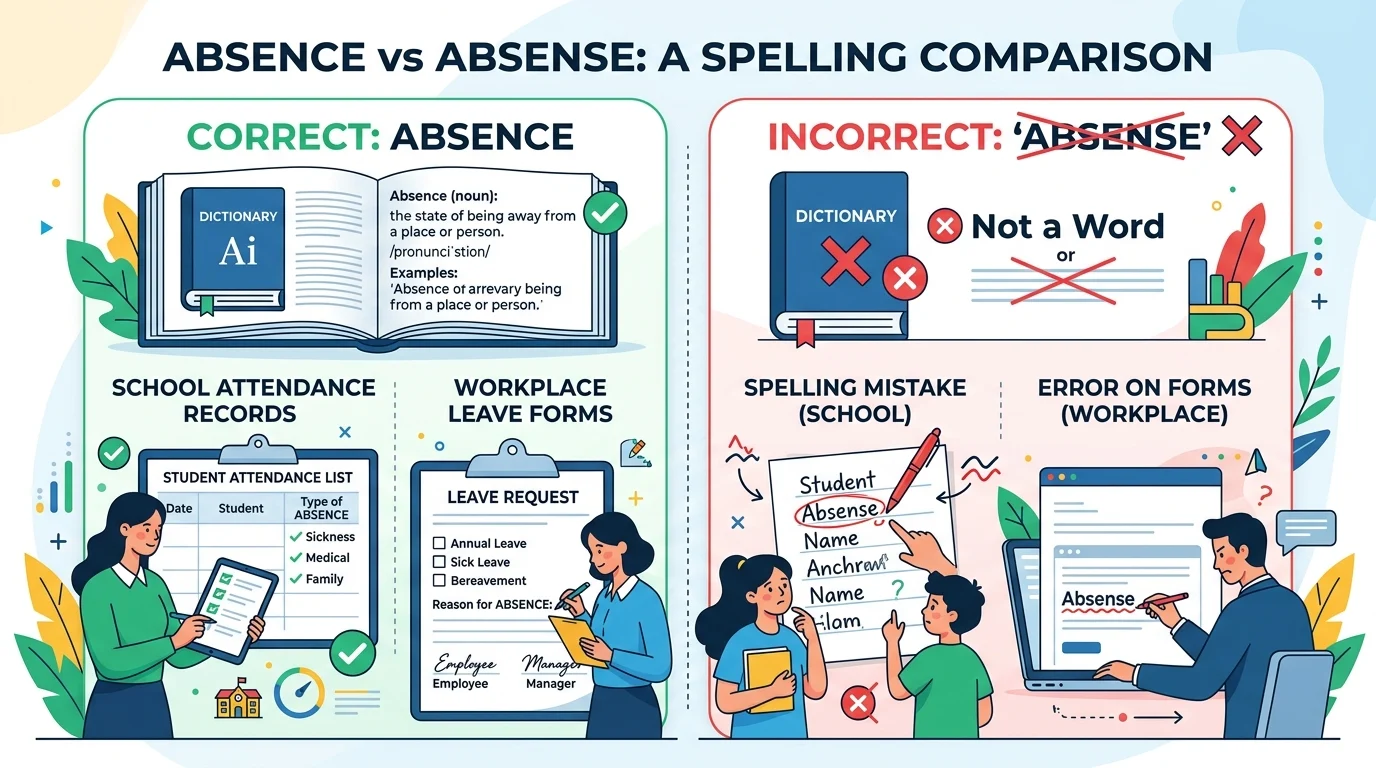
The confusion between absence vs absense is a common spelling mistake in English. Since the words sound nearly identical when spoken, many writers accidentally replace the c with an s. However, only one spelling is recognized in standard English.
If you’re unsure whether to write absence or absense, this guide explains the correct spelling, meaning, examples, common mistakes, and helpful memory tips.
Quick Answer
✅ Absence is the correct spelling.
❌ Absense is incorrect.
Correct example:
- “Her absence was noticed during the meeting.”
Incorrect example:
- “Her absense was noticed during the meeting.”
Always use absence in formal and informal writing.
What Does Absence Mean?
English Vocabulary Absence is a noun that means:
- the state of being away
- the lack of someone’s presence
- something that is missing or unavailable
Examples of Absence
- His absence from work was unexpected.
- The teacher noted her absence.
- The absence of evidence is not evidence of absence.
- We felt her absence at the family gathering.
Why Is “Absense” Incorrect?
The spelling absense is a common misspelling caused by pronunciation confusion.
People often write it incorrectly because:
- the ending sounds like -sense
- many English words end in -sense
- they spell the word based on sound rather than memorization
However, dictionaries recognize only:
✅ absence
❌ absense
Absence vs Absense: Main Difference
| Word | Status | Meaning |
|---|---|---|
| Absence | ✅ Correct | State of being away or missing |
| Absense | ❌ Incorrect | Common spelling mistake |
Common Uses of Absence
School Attendance
Education
- The student submitted a note explaining her absence.
- Excessive absence may affect grades.
Workplace
- His absence delayed the project.
- Management approved her leave of absence.
Family and Relationships
- We felt his absence during the celebration.
- Her long absence was difficult for the family.
General Lack of Something
- The absence of communication caused confusion.
- The absence of rain affected crops.
Common Expressions With Absence
Leave of Absence
A period of approved time away from work or school.
Example:
- She requested a leave of absence.
In the Absence Of
Meaning “when something or someone is not present.”
Example:
- In the absence of evidence, the case was dismissed.
Absence Makes the Heart Grow Fonder
A common saying meaning that time apart can increase affection.
Examples of Absence in Sentences
- Her absence was immediately noticed.
- The manager explained his absence.
- The absence of noise was refreshing.
- Their absence created a gap in the team.
Common Mistakes People Make
Mistake 1: Writing Absense
Incorrect:
- absense
Correct:
- absence
Mistake 2: Confusing Similar Endings
Words such as:
- sense
- nonsense
- common sense
may cause people to incorrectly write absense.
Mistake 3: Spelling by Pronunciation
English spelling often differs from pronunciation, which leads to mistakes like this one.
Synonyms for Absence
Depending on the context, alternatives include:
- nonattendance
- unavailability
- lack
- omission
- vacancy
- nonappearance
Example
Instead of:
- “His absence was noted.”
You could say:
- “His nonattendance was noted.”
American vs British English Differences
Both:
- United States American English
- United Kingdom British English
use:
✅ absence
There is no spelling difference.
Why Correct Spelling Matters
Professional Communication Correct spelling improves:
- professionalism
- readability
- credibility
- communication clarity
Since absence frequently appears in school, workplace, and legal documents, correct spelling is especially important.
Easy Trick to Remember
Think of “Absent”
The word absence comes from:
absent → absence
Notice that absent contains a c sound when transformed into absence.
Memory Tip
If you know how to spell:
- absent
then you can remember:
- absence
Remember:
- absence ✅
- absense ❌
Related Word Forms
| Word | Part of Speech |
|---|---|
| Absent | Adjective |
| Absence | Noun |
| Absently | Adverb |
| Absentee | Noun |
Example Sentences
- He was absent yesterday.
- His absence was recorded.
- She absently stared out the window.
- Several absentees missed the event.
FAQs
Which spelling is correct: absence or absense?
Absence is the correct spelling.
Is absense a real word?
No. Absense is considered a misspelling of absence.
What does absence mean?
It means the state of being away or the lack of someone’s presence.
How do you use absence in a sentence?
Example: “Her absence affected the team’s performance.”
Is absence a noun?
Yes. It is a noun referring to being away or missing.
Why do people spell absence as absense?
Because the ending sounds similar to words that end in -sense.
Do British and American English spell absence differently?
No. Both use absence.
Can spell-check catch absense?
Yes. Most spell-check tools flag absense as incorrect and suggest absence.
Final Summary
The difference between absence vs absense is simple. Absence is the correct English spelling and refers to the state of being away or missing. Absense is a common spelling mistake that should be avoided in all forms of writing.
Whether you’re discussing school attendance, workplace leave, or the lack of something important, always use absence. Remember that the word contains a c, not an s, before the ending.
Actionable Takeaway
Keep this rule in mind:
- absence = correct spelling ✅
- absense = incorrect spelling ❌
For accurate and professional writing:
- leave of absence ✅
- leave of absense ❌
A quick check for the c can help you avoid this common spelling error.